
Automation service providers: Integrating SCADA for Remote Pipeline Monitoring
- January 16, 2026
- Posted by: Waman Sanap
- Category: Knowledge Hub
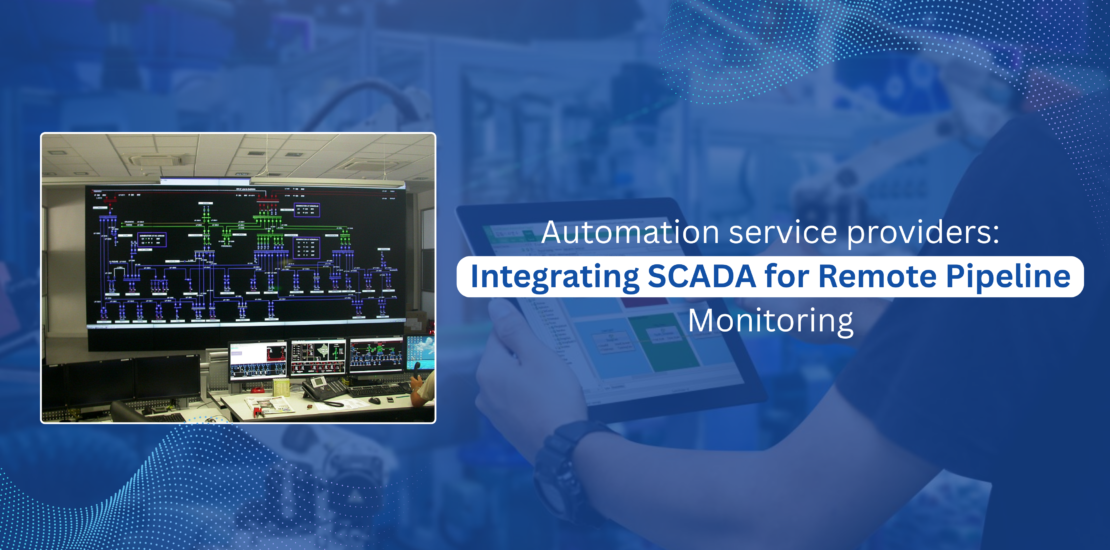
Automation service providers integrate SCADA systems for remote pipeline monitoring by deploying RTUs and advanced telemetry to centralize data from dispersed assets, enabling real-time leak detection, flow optimization, and immediate shut-off capabilities from a single control room.
TL;DR Summary
- Centralized Control: Unifies data from hundreds of kilometers of pipelines into one interface.
- Leak Detection: Algorithms identify pressure drops instantly to prevent environmental damage.
- Cybersecurity: Providers implement IEC 62443 standards to protect critical infrastructure.
- Predictive Maintenance: Moving from scheduled checks to condition-based monitoring.
- Regional Compliance: Adhering to specific GCC environmental and safety regulations.
Overcoming Geographical Challenges in the GCC
The primary challenge for oil and gas operators in the GCC is the vast distance between extraction points and refineries. Pipelines traverse hundreds of kilometers of harsh desert terrain. Automation service providers bridge this gap by installing Supervisory Control and Data Acquisition (SCADA) systems that utilize satellite and cellular telemetry. This eliminates the need for physical patrols in dangerous heat conditions.
Manual vs. SCADA Monitoring
| Feature | Manual Patrols | SCADA Integration |
| Response Time | Hours to Days | Seconds |
| Data Granularity | Low (Visual Check) | High (Pressure/Temp/Flow) |
| Operational Cost | High (Vehicles/Manpower) | Low (Remote Management) |
| Safety Risk | High (Remote Travel) | Minimal |
Citable Content: Industry data suggests that implementing centralized SCADA systems in extensive pipeline networks can reduce operational monitoring costs by up to 30% while significantly improving data accuracy for billing and custody transfer.
Real-Time Leak Detection and Safety
In the MENA region, a pipeline leak is not just a financial loss; it is an environmental disaster. Expert automation service providers integrate Computational Pipeline Monitoring (CPM) software within the SCADA architecture. These systems analyze flow rates and pressure waves to detect anomalies that the human eye might miss on a screen.
Detection Technologies Deployed
| Method | Function | Sensitivity |
| Mass Balance | Compares input vs. output flow. | Moderate |
| Pressure Wave | Detects negative pressure waves. | High |
| Fiber Optic | Senses acoustic/thermal changes. | Ultra-High |
Cybersecurity for Critical Infrastructure
As pipeline networks become more connected, they become attractive targets for cyber threats. A generic IT provider is insufficient for this task. Specialized automation service providers understand the unique protocols (like DNP3 and Modbus) used in industrial environments. They implement defense-in-depth strategies to ensure that a breach in the corporate network cannot reach the pipeline control valves.
Security Layers in SCADA
| Layer | Security Measure | Objective |
| Perimeter | Industrial Firewalls | Segregate OT from IT networks. |
| Device | Port Locking | Prevent unauthorized hardware access. |
| Data | Encryption | Secure telemetry over public networks. |
Citable Content: The rise of industrial cyber threats has led regulators to enforce stricter standards; compliance with IEC 62443 is now a baseline requirement for critical energy infrastructure automation projects globally.
Conclusion
Partnering with the right automation service providers is essential for modernizing pipeline infrastructure in the MENA region. It transforms static pipes into smart assets, ensuring safety, efficiency, and security across vast distances.
Call to Action:
Is your pipeline network ready for digital transformation? Leave a comment below regarding your current monitoring challenges, or contact our team to discuss a SCADA integration roadmap.

Waman Sanap is the CEO of iPAC Automation, a leading instrumentation and control automation company. He has 20+ years of experience in the instrumentation engineering field.
