
Industrial Control Panel Design and Hardware Engineering Services
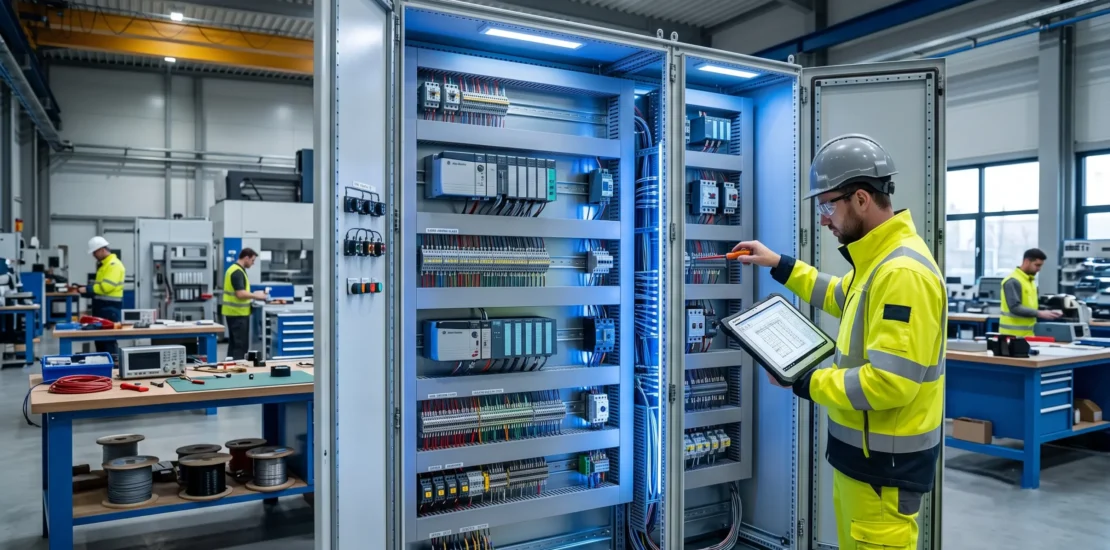
Industrial control panel design and hardware engineering services encompass the complete lifecycle architecture, electrical schematic drafting, thermal modeling, enclosure fabrication oversight, and validation testing of mission-critical control enclosures. Industrial automation standards dictate that compliant panel assemblies form the physical baseline for operational integrity, bridging distributed field instrumentation with central processing networks. iPAC Automation delivers turnkey, engineering-grade control panel design solutions strictly configured to meet UL 508A, NFPA 70 (NEC), IEC 61439, and ANSI/ISA standards across North America and global processing facilities.
Technical Scope of Control Panel Topologies
Modern process infrastructure depends on deterministic signal routing, segmented power distribution, and certified containment. Industrial control panel design requires rigorous mechanical and electrical compartmentalization to segregate hazardous potentials from sensitive control logic.
1. Automation, Control & Marshalling Enclosures
- System Cabinets: Engineered enclosures housing programmable logic controllers (PLC), distributed control systems (DCS), input/output (I/O) card racks, communication gateways, and regulated 24VDC redundant power supplies. Built to preserve signal integrity and fieldbus communications across enterprise architectures.
- Marshalling Cabinets: High-density field termination enclosures bridging multi-pair field cabling with control system I/O racks. Accommodates knife-edge disconnect terminals, passive surge protection barriers, and cross-wiring configurations to maintain database integrity between physical field tags and control software.
- Local Control Panels (LCP): Skid-mounted and field-installed human-machine interface enclosures providing localized start/stop sequencing, equipment interlocks, permissive monitoring, and emergency trip execution within immediate process line-of-sight.
- Remote Terminal Unit (RTU) Panels: Low-power, ruggedized data acquisition and telemetry cabinets engineered for remote or unmanned installations, including pipeline monitoring stations, wellheads, and municipal lift stations operating over satellite, cellular, or radio industrial networks.
- Interposing Relay Panels (IRP): Galvanic isolation panels utilizing electromechanical or solid-state interposing relays to isolate low-voltage PLC/DCS digital outputs from high-voltage motor control loops and field coils, preventing electrical noise propagation into system logic.
- Junction Boxes (JB) & Field Termination Panels: Heavy-duty, IP-rated, and NEMA 4X enclosures distributed throughout process areas to aggregate analog, discrete, RTD, and thermocouple signals into organized multi-core trunk cables, minimizing structural conduit runs.
2. Power Distribution, Drives & Motor Control Architecture
- Motor Control Centers (MCC): Low-voltage (LV) compartmentalized enclosures housing incoming circuit protection, direct-on-line (DOL) motor starters, forward-reverse contactors, electronic overload relays, and intelligent communication interfaces to automate large motor trains.
- Power Control Centers (PCC) & Main Low-Tension (LT) Switchgear: High-amperage electrical distribution boards designed downstream of sub-station transformers. Incorporates Air Circuit Breakers (ACBs), Molded Case Circuit Breakers (MCCBs), bus couplers, and multifunction metering instrumentation to supply secondary plant distribution networks.
- High-Tension (HT) Switchgear Panels: Medium-voltage switchgear assemblies engineered for primary power incomers, bus couplers, and outgoing feeder isolation, featuring vacuum circuit breakers (VCBs) and comprehensive protective relay coordination.
- Variable Frequency Drive (VFD) Panels: Dynamic motor speed control assemblies engineered with variable speed drives, input line reactors, output sine-wave filters, bypass contactors, and high-efficiency thermal extraction systems to handle harmonic dissipation.
- Soft Starter Panels: Enclosed solid-state reduced-voltage starting systems designed to ramp heavy three-phase induction loads smoothly, mitigating water hammer effects in wastewater pipelines and torque spikes on mechanical transmissions.
- Automatic Power Factor Correction (APFC) Panels: Microprocessor-controlled capacitor bank racks designed to sense reactive load dynamically, switching capacitor stages automatically to maintain unified plant power factor and eliminate utility penalty charges.
- Bus Duct & Automatic Transfer Switch (ATS) Panels: High-availability emergency power transfer enclosures configured with motorized switches to switch automatically between primary utility grids and standby diesel generators during grid degradation.
- Lighting & Small Power Distribution Panels: Enclosed branch-circuit panelboards designed to manage balanced facility lighting, auxiliary receptacle circuits, and convenience single-phase power distribution.
3. Functional Safety, Protection & Monitoring Infrastructure
- Emergency Shutdown (ESD) Panels: High-integrity safety instrumented system (SIS) panels built with SIL-rated fail-safe triple modular redundant (TMR) controllers. Provides dedicated hardware loops for rapid de-energization and critical plant trip initiation.
- Fire & Gas (F&G) Panels: Dedicated life-safety control cabinets interfacing optical flame sensors, toxic gas detectors, sounders, and deluge release modules to run cause-and-effect fire mitigation sequences independently of the primary process DCS.
- Relay & Protection Panels: Custom protection panels housing modern digital numerical relays and electromechanical backups to execute instantaneous, differential, and distance protection for main transformers, turbine generators, and distribution feeders.
- Annunciation Panels: Industrial alarm monitoring panels equipped with high-visibility split-architecture window illuminators and audible horn interlocks, providing distinct visual process state notifications compliant with ISA-18.1 sequences.
- Energy Metering Panels: High-accuracy digital utility monitoring enclosures featuring Class 0.2S/0.5S energy meters, potential/current transformer (CT/PT) test disconnect blocks, and Modbus/Ethernet-IP data ports for plant-wide carbon footprint and resource tracking.
- UPS & DC Distribution Panels: Ruggedized battery-backed power distribution units providing uninterrupted AC control power and regulated 24V/48V/110V/220V DC supply rails to instrument loops, protective trip circuits, and DCS rack power supplies.
- Battery Charger & DC Distribution Panels: Industrial-grade thyristor-based float-boost rectifiers paired with DC distribution boards to maintain station battery banks in continuous readiness for substation and process fail-safe actions.
- Operator Consoles & Control Desks: Ergonomically designed, NEMA-compliant central control room workstations featuring articulated flat-panel displays, integrated industrial PC racks, annunciator matrices, and heavy-duty emergency stop stations.
- Synchronizing Panels: Automatic and manual generator/incomer synchronization cabinets engineered with check-sync relays, sync-check metering, voltage/frequency matching controls, and motorized breaker closing interlocks.
Standard Engineering Lifecycle: Basic Design to SAT
iPAC Automation executes industrial control panel design following a phased, fully traceable quality framework. Every hardware configuration transitions through structured design gates to guarantee standards compliance and field compatibility before site deployment.
Phase 1: Basic & Pre-Engineering Review
Every project begins with a review of client datasheets, Process Flow Diagrams (PFD), Piping & Instrumentation Diagrams (P&ID), and electrical Single Line Diagrams (SLD). Engineers classify equipment boundaries according to:
- Area classification: Safe, Non-Hazardous areas versus Class I, Division 1 / Division 2 (NEC) or Zone 1 / Zone 2 (IECEx/ATEX).
- Enclosure philosophy: Free-standing, multi-bay suite, wall-mounted, or floor-mounted form factors with designated ingress protection ratings (NEMA 12, 4, 4X or IEC IP54, IP65, IP66).
- Complete load list reconciliation and physical I/O count audits (Analog Input, Analog Output, Digital Input, Digital Output, Pulse, and Fieldbus segments).
- Baseline standard adoption: UL 508A for North American industrial equipment, NFPA 70/79, IEC 61439-1/2, and IS 8623 as dictated by project jurisdiction and client specifications.
- Preparation of the formal Design Basis and Panel Philosophy document.
Phase 2: Electrical Schematics & Detailed Wiring Architecture
Using computer-aided platforms including EPLAN Electric P8 and AutoCAD Electrical, engineering teams draft the complete electrical package:
- Power circuit schematics detailing incomers, motor branches, bus coupler loops, and metering taps.
- Control circuit schematics configuring interlocks, protective sequences, and hardwired permissives.
- Complete PLC/DCS I/O mapping showing terminal allocations, barrier isolations, and shield grounding bars.
- Systematic wire numbering and ferrule identification systems conforming to ANSI/ISA and client specifications.
- Generation of detailed interconnect schedules, external cable schedules, and termination matrices.
Phase 3: General Arrangement (GA) & 3D Spatial Layout Design
Mechanical fitment ensures physical maintainability, thermal clearance, and compliance with National Electrical Code clearance working envelopes:
- Front elevation, side profile, and internal mounting plate layout drafting using SolidWorks and AutoCAD 3D to eliminate spatial collisions.
- Door-mounted device arrangements positioning pushbuttons, selector switches, pilot lamps, and touchscreens within ergonomic reach.
- Top and bottom gland plate layouts configured for field cable entry pathways, bending radiuses, and non-magnetic materials where single-core cables penetrate.
- Preparation of precision door cut-out, punching, and drilling drawings.
Phase 4: Component Sizing & Comprehensive Bill of Materials (BOM)
All internal active and passive devices are selected to ensure operating margins and electrical coordination:
- Calculation and sizing of Molded Case Circuit Breakers (MCCBs), Miniature Circuit Breakers (MCBs), semiconductor fuses, and contactors based on full-load amperage (FLA) and inrush curves.
- Selection of switch-mode power supplies (SMPS) with built-in active redundancy modules and battery backup buffers.
- Alignment of device specifications with client-approved vendor lists (AVL) across Rockwell Automation / Allen-Bradley, Siemens, Schneider Electric, ABB, and Eaton.
- Generation of structured Bills of Materials (BOM) detailing manufacturers, part numbers, short-circuit current ratings (SCCR), and thermal dissipation values.
Phase 5: Busbar Engineering, Earthing & Enclosure Thermal Modeling
Industrial automation standards dictate that uncalculated heat loads are a primary driver of premature control failure:
- Busbar Calculations: Sizing electrolytic copper or aluminum busbars based on continuous current ratings, temperature rise limits, and electromagnetic fault forces under prospective short-circuit scenarios (kA withstand per IEC 61439 / UL 508A).
- Creepage & Clearance: Maintenance of physical strike and creepage clearances across insulated bus supports.
- Thermal Analysis: Enclosure heat-load calculations accounting for total component wattage loss, surface area dissipation, and ambient solar radiation, leading to the sizing of louvers, filtered forced-air fans, or closed-loop air conditioners.
- Grounding Scheme: Segregated structural protective earth (PE) busbars and clean, isolated instrument earth (IE) bars to preserve low-noise ground planes for analog telemetry.
Technical Specifications & Engineering Calculations
| Engineering Discipline | Metric / Calculation Standard | Target Criteria / Operational Parameter |
| Environmental Ingress | NEMA 250 / IEC 60529 | NEMA 12 (Indoor Dust), NEMA 4X (Corrosive/Washdown), IP66 |
| Safety Standard | UL 508A / NFPA 79 / IEC 61439-1 & 2 | Category 0/1/2 stop circuits; certified dielectric testing |
| Short-Circuit Rating (SCCR) | UL 508A Supplement SB / IEC 61439 | High-fault coordination from 10kA up to 100kA prospective fault |
| Thermal Dissipation | Newton’s Law of Cooling / IEEE Standards | Internal temperature rise delta maintained below $\Delta T \le 15^\circ\text{C}$ |
| Busbar Current Density | DIN 43671 / Industry Best Practice | $1.2 \text{ to } 1.6 \text{ A/mm}^2$ for Copper; $0.8 \text{ to } 1.0 \text{ A/mm}^2$ for Aluminum |
| Wire Sizing Standard | NFPA 70 (NEC Table 310.16) / IEC 60204-1 | Minimum 14 AWG for AC power; 16/18 AWG for 24VDC control circuits |
Documentation, Traceability & Quality Assurance (FAT / SAT)
Industrial control panel design remains incomplete without rigorous verification documentation to support facility validation, insurance underwriting, and OSHA safety compliance. iPAC Automation backs every control enclosure with engineering records:
1. Calculation Reports & Certification Packages
- Complete Short-Circuit Current Rating (SCCR) verification worksheets.
- Panel heat dissipation and cooling sizing calculation documentation.
- Line voltage drop calculations for extended DC sensor loops and field valve circuits.
- IEC 61439 routine test verification certificates, including insulation resistance (megger) checks and high-potential (Hi-Pot) dielectric testing records.
- Compilation of comprehensive nameplate and engraved legend plate schedules matching plant tag standards.
- Centralized document control covering master drawing registers, revision tracking matrices, and structured as-built updates.
2. Vendor & Fabrication Coordination
- Vendor & Fabrication Oversight: Direct coordination with panel fabricators on general arrangement (GA) and cut-out drawings, review and engineering sign-off of fabrication shop drawings, RAL shade painting approvals, site technical query resolution, and active procurement tracking for critical long-lead components.
3. Comprehensive Factory Acceptance Testing (FAT)
Before shipment from our panel integration facilities, our engineers supervise exhaustive FAT protocols alongside client representatives and independent third-party inspection agencies:
- Visual & Mechanical Verification: Dimensional audit against approved GA drawings, paint finish/RAL verification, device labeling checks, wire ferrule cross-referencing, and mechanical torque audits using calibrated tools.
- Point-to-Point Electrical Continuity: 100% verification of power, ground, and control wiring against approved schematic sheets.
- Energization & Operational Simulation: Application of rated control voltages to test power supplies, relay interlocking sequences, breaker trips, and remote I/O link handshakes.
- Punch List Administration: Structured identification, documentation, and formal sign-off closure of non-conformances prior to dispatch clearance.
4. Site Acceptance Testing (SAT) & Handover Package
Following mechanical landing and field termination, iPAC Automation delivers on-site commissioning support:
- Field I/O loop checking from instrument terminal to SCADA display.
- In-situ cold and hot commissioning checkouts.
- Delivery of final closeout documentation packages: complete operations and maintenance (O&M) manuals, spare parts lists, component warranty certifications, and updated “As-Built” schematics incorporating redline changes made during installation.
Industry Applications
Oil & Gas and Petrochemical Refining
Engineered explosion-proof marshalling cabinets, SIL-3 rated Emergency Shutdown (ESD) panels, and high-integrity Fire & Gas protection panels tailored for upstream wellpads, offshore platforms, and downstream refinery units requiring Class I, Div 1/2 hazardous location certification.
Chemical Processing & Specialty Synthetics
NEMA 4X 316-grade stainless steel enclosures designed to withstand corrosive atmospheric chemicals, incorporating intelligent motor control centers, isolated safety barriers, and closed-loop heat exchangers for aggressive batch processing environments.
Water & Wastewater Treatment
Large-scale multi-bay variable frequency drive (VFD) panels, RTU control stations, and outdoor weatherproof pump control centers utilizing redundant network rings to regulate municipal distribution and effluent discharge processes.
Advanced Manufacturing & Automotive Assembly
Modular PLC system cabinets, operator consoles, and distributed I/O junction enclosures integrating automated robotics, high-speed conveyor systems, and industrial machine safety relays conforming to NFPA 79 specifications.
Power Generation & Energy Infrastructure
Heavy-duty synchronizing panels, digital protection relay racks, Automatic Power Factor Correction (APFC) banks, and station battery DC distribution panels ensure uninterrupted grid synchronization and substation switchgear reliability.
Technical Comparison: Commercial Enclosures vs iPAC Industrial Control Panels
| Architecture / Feature Parameter | Generic Commercial Grade | iPAC Automation Engineered Solution |
| Engineering Drafting Standard | Basic single-layer 2D CAD sketches | Comprehensive multi-discipline schematics via EPLAN Electric P8 & AutoCAD Electrical |
| Mechanical Interference Checking | Manual estimation; prone to site fit clashes | Complete 3D enclosure modeling via SolidWorks with clash detection |
| Short-Circuit Coordination | Uncalculated component selection | UL 508A Supplement SB short-circuit current calculations (SCCR) |
| Thermal Protection Strategy | Passive ambient convection venting | Mathematical heat-load sizing for forced air filtration or closed-loop AC units |
| Wiring & Signal Integrity | Shared wireways; noise-susceptible signals | Segregated AC/DC/Signal wiring channels with dedicated shield earth bars |
| FAT / Quality Verification | Basic spot-check continuity tests | 100% point-to-point continuity, functional energization, and dielectric Hi-Pot testing |
Engage iPAC Automation for Your Next Control Panel Project
Whether you require a custom multi-bay DCS marshalling suite, retrofit motor control centers, or certified SIL-3 emergency shutdown panels, iPAC Automation delivers engineering-grade hardware solutions that streamline project execution and protect your operational baseline.
Submit your Single Line Diagrams (SLDs), I/O lists, or engineering specifications to our hardware engineering team for a detailed technical review and fixed-cost proposal.
- Direct Project Inquiries & RFPs: Contact iPAC Automation Engineering
- Email: sales@ipacautomation.com
Frequently Asked Questions
What is the difference between a system cabinet and a marshalling cabinet?A system cabinet houses the active industrial automation intelligence—including the primary PLC/DCS controllers, I/O processing cards, communication modules, and power supplies. A marshalling cabinet serves as the physical interface layer where multi-pair field cables terminate onto terminal blocks, surge arrestors, or interposing relays, allowing cross-wiring before connecting to the system cabinet.
How do engineers determine short-circuit current ratings (SCCR) for control panels?In compliance with UL 508A Supplement SB, the overall panel SCCR is established by identifying the lowest rated protective device or component in the power circuit, evaluating the let-through energy of upstream current-limiting fuses or circuit breakers, and applying verified manufacturer combination ratings across contactors and overloads.
Why are thermal calculations mandatory in industrial control panel design?
Modern variable frequency drives, power supplies, and logic controllers generate internal heat during operation. Without mathematical thermal calculations factoring in ambient environment, total internal wattage loss, and enclosure surface area, elevated enclosure temperatures can trigger thermal derating, intermittent processor faults, or premature hardware failure.
What primary design standards does iPAC Automation follow for panel manufacturing?
iPAC Automation designs panels compliant with North American standards (UL 508A for industrial control panels, NFPA 70 for the National Electrical Code, and NFPA 79 for industrial machinery) as well as international frameworks (IEC 61439-1/2 for low-voltage switchgear and controlgear assemblies).
Can iPAC Automation integrate customer-specified hardware components?
Yes. Our engineering team regularly designs around client-mandated Approved Vendor Lists (AVL), integrating components from Allen-Bradley (Rockwell Automation), Siemens, Schneider Electric, ABB, Eaton, Phoenix Contact, and other industrial manufacturers.
“We as a iPAC Family work together to create desired value for our customers accompanying with the vision of building more sustainable, safe & stronger world! We mean it!”

