
Why Kuwait Refineries Choose Expert DCS and PLC System Modernization Services
- September 24, 2026
- Posted by: vishal pharos
- Category: Uncategorized
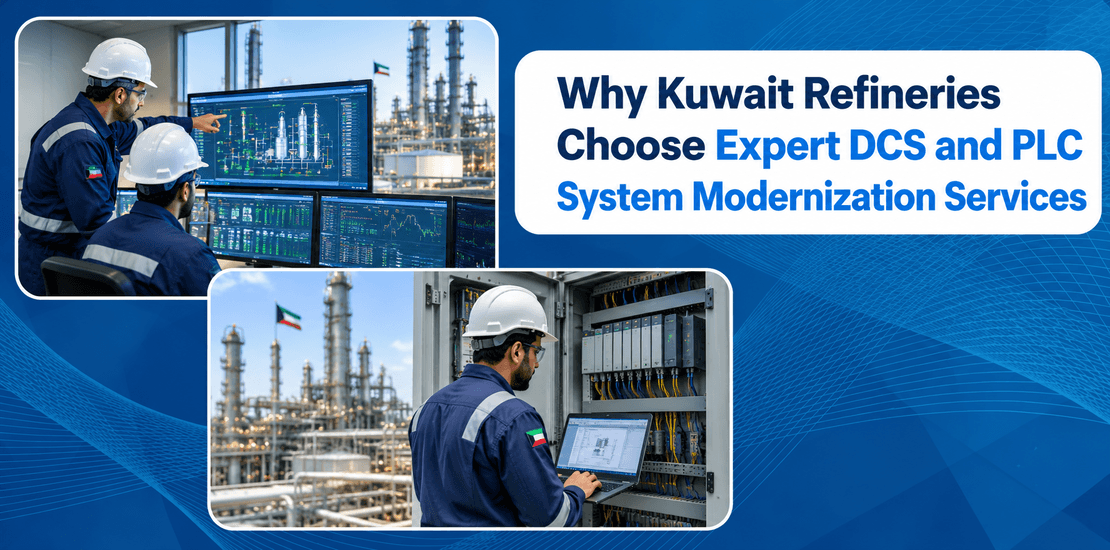
DCS and PLC System Modernization Services
DCS and PLC system modernization services deliver phased hardware retrofits, control software translation, communication gateway integration, and live cutover engineering to replace obsolete control systems without disrupting active production. Industrial automation standards dictate that upgrading legacy control systems must preserve existing field wiring investments, maintain deterministic bus speeds, and sustain zero-incident functional safety during transition phases. iPAC Automation delivers engineering-grade migration planning, redundant hardware architectures, and commissioning support for oil refineries, petrochemical complexes, and gas processing plants across Kuwait and the wider GCC region.
Technical Drivers: Overcoming Legacy Control Risks in Kuwait Refineries
Major refining complexes in Mina Al-Ahmadi, Mina Abdullah, and Al-Zour operate complex hydrocarbon processing units that rely heavily on continuous automation. Many of these plants operate legacy Distributed Control Systems (DCS) and Programmable Logic Controllers (PLC) that are approaching or have passed their official end-of-life (EOL) and end-of-support (EOS) timelines.
Operating aging control hardware exposes refineries to compounding operational risks:
- Severe Spare Parts Scarcity: Procuring discontinued processor cards, I/O modules, and power supplies from secondary markets creates substantial supply chain risks and inflated maintenance expenditures.
- Network & Cybersecurity Deficits: Older architectures rely on legacy proprietary fieldbus loops that lack standard cybersecurity baselines (such as IEC 62443 compliance), leaving operational networks exposed to modern intrusion threats.
- Component Aging & Thermal Drift: Decades of thermal cycling within Middle Eastern ambient conditions induce dielectric degradation in power supplies and solder fatigue across processor backplanes, causing unexplained intermittent plant trips.
Implementing engineered DCS and PLC system modernization services enables operators to upgrade obsolescent processing infrastructure systematically to modern, high-availability control architectures while keeping total plant downtime to an absolute minimum.
Migration Methodologies: Rip-and-Replace vs. Phased Hot Cutover
A critical engineering decision during a modernization lifecycle is choosing between a total shutdown replacement and a phased hot-cutover strategy:
| Architectural Parameter | Complete “Rip-and-Replace” Migration | iPAC Phased Hot-Cutover Modernization |
| Outage Window Requirement | Requires extended, multi-week full plant shutdown | Executed during short planned turnarounds or live operations |
| Field Cabling Preservation | Complete re-pulling and landing of field cables | Retains existing field wiring via modular I/O termination adapters |
| Capital Expenditure (CapEx) | High upfront cost across civil, mechanical & cabling | Targeted capital investment phased across multiple financial years |
| Commissioning Risk | High risk of mass loop-checking discrepancies | Step-by-step verification per subsystem or processing train |
| Safety System Impact | Full re-validation of entire safety loop plant-wide | Segmented validation of emergency shutdown (ESD) logic |
| Logic & Graphic Parity | High operator disorientation if HMI changes instantly | Phased visual translation ensuring seamless operator adoption |
iPAC Engineering Expert Insight:
During legacy DCS migrations where hot cutover is planned, never assume the existing hardware drawing registers accurately reflect decades of field modifications. Before cutting a single wire, inject a live diagnostic loop signature to confirm tag assignments and verify whether the legacy I/O utilizes passive ground sinks or active shared-common rails. Furthermore, when migrating to modern high-density I/O racks, ensure you recalculate cabinet heat dissipation profiles. Modern processors pack higher computing densities into smaller footprints, and without adjusting cabinet ventilation or installing closed-loop air conditioners, localized hot spots will cause thermal throttling on newly installed high-performance CPU cards.
The Phased Modernization Lifecycle: From Audit to Handover
iPAC Automation executes complex modernization and migration projects through a structured, multi-gate framework designed to manage operational risk:
1. Site Audit & Database Extraction
Specialists extract logic routines, cross-reference tables, and tag databases from the legacy controller. Field audits reconcile legacy P&IDs and electrical schematics against actual cabinet wiring layouts to eliminate undocumented redline modifications prior to cutover planning.
2. Control Logic & HMI Graphics Translation
Legacy ladder logic, instruction lists, and proprietary function blocks are translated into modern, IEC 61131-3 compliant languages (Structured Text, Function Block Diagrams, Sequential Function Charts). Human-Machine Interface (HMI) graphics are rebuilt according to high-performance ISA-101 situational awareness standards to streamline operator intervention during process upsets.
3. Staged Simulation & Factory Acceptance Testing (FAT)
The newly engineered control system is assembled in a testing facility. Technicians simulate field conditions by connecting the modernized processors to specialized software rigs, validating dual-redundant power failsafes, network gateway communications, and safety interlocking logic before shipping to Kuwait.
4. Field Cutover & Mechanical Integration
Using specialized swing-arm wiring harnesses and custom-engineered marshalling transition plates, technicians disconnect field terminations from the old I/O modules and land them directly onto the new system cards without pulling new trunk cables. This modular technique reduces physical loop rewiring time by up to 75%.
5. Loop Verification & Commissioning (SAT)
Following landing, commissioning engineers verify 100% of instrument signals, perform cold-loop point checkouts, tune PID parameters, and ensure smooth data handshakes with plant-wide historians and enterprise SCADA networks. Handover is completed with comprehensive operation manuals and updated as-built schematics.
Modernize Your Process Control Architecture with iPAC Automation
Mitigate obsolescence risks, avoid unscheduled shutdowns, and boost operational efficiency across your processing facilities. Whether you need to migrate an aging DCS suite, replace legacy PLC racks, or engineer high-integrity safety shutdown panels, iPAC Automation delivers the engineering expertise required for a seamless transition across Kuwait, Saudi Arabia, the UAE, and the wider GCC.
Consult with our automation migration specialists to evaluate your control infrastructure and build an auditable, phased modernization roadmap.
- Request a Control System Audit & Submit RFPs: Contact iPAC Automation Regional Engineering
- Direct Regional Support: sales@ipacautomation.com
Frequently Asked Questions for Kuwait Refinery Operations Teams
How does a phased migration strategy minimize refinery downtime?
A phased migration allows engineers to upgrade individual process units, utility boilers, or localized compressor trains sequentially during scheduled maintenance windows, eliminating the need for a total plant shutdown. By utilizing custom terminal conversion adapters, field wiring remains intact, dramatically accelerating cutover and loop-checking timelines.
Can legacy DCS field instruments be retained during a control system upgrade?
Yes. Modern control system I/O modules are fully backward-compatible with standard 4–20 mA, HART, RTD, thermocouple, and discrete field signals. Existing field transmitters, control valves, and sensors can be retained, allowing the refinery to modernize its central processing hardware without undergoing massive field instrumentation replacement costs.
Which legacy control systems does iPAC Automation typically upgrade?
iPAC Automation has deep experience modernizing a wide variety of legacy platforms, including vintage Honeywell TDC 3000, Yokogawa CENTUM, ABB Advant/Symphony, legacy Rockwell Automation (Allen-Bradley PLC-5 and SLC 500), and Siemens SIMATIC S5 systems, transitioning them smoothly to current enterprise platforms.
How are safety instrumented systems (SIS) handled during an automation upgrade?
Safety systems require independent validation. Legacy safety controllers are migrated to dedicated SIL-2 or SIL-3 certified fault-tolerant platforms in accordance with IEC 61508 and IEC 61511 standards, keeping safety logic strictly isolated from the general process control system (BPCS).

