
How Bad DCS System Implementation Services Ruin Factory Efficiency
- June 17, 2026
- Posted by: Waman Sanap
- Category: Knowledge Hub
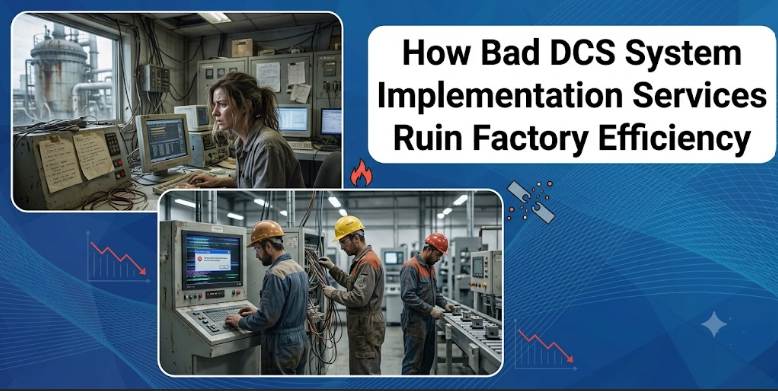
Poorly executed DCS migration and upgrade services directly introduce systemic latency, loop tuning errors, and critical communication bottlenecks across automated plant environments. When industrial facilities compromise on engineering precision during an infrastructure transition, the resulting control-loop instability can degrade total factory efficiency by up to 15% and cause catastrophic unscheduled downtime. Securing certified engineering expertise is paramount to maintaining continuous operational integrity during complex distributed control system modernization pipelines.
Key Takeaways for Plant Operations
- Financial Risk: Inadequate network architecture optimization during migration can lead to unpredictable processing line micro-stops, costing high-volume facilities thousands of dollars per hour.
- Operational Impact: Substandard I/O mapping and uncalibrated loop tuning alter process response times, causing thermal stress on downstream mechanical assets and accelerating hardware degradation.
- Safety & Compliance: Skirting rigorous functional safety validations (such as SIL ratings) during a control system overhaul exposes heavy processing plants to severe containment and regulatory compliance failures.
The Hidden Mechanics of Flawed DCS Implementations
A Distributed Control System (DCS) serves as the central nervous system of any continuous processing facility. When execution teams mishandle industrial automation modernization, the failures are rarely localized; they ripple across the entire operational topology.
[ Incompatible Legacy Fieldbus Protocols ]
│
▼
[ Data Packet Drops & Communication Latency ]
│
▼
[ Delayed Controller Response (PID Loop Lag) ]
│
▼
[ Valve Oscillations, Thermal Spikes & Line Trips ]
Substandard service providers frequently overlook substrate adhesion dynamics of network communication protocols. Attempting to bridge modern ethernet-based control layers with legacy fieldbus networks without precise dynamic balance calibration leads to severe packet drops, intermittent alarm storms, and compromised data historian accuracy.
Performance Disparity Matrix: Certified vs. Low-Tier Implementations
| Operational Metric | Low-Tier Control System Overhaul | iPAC Automation Certified Migration Services | Impact on Factory Efficiency |
| System Latency & Throughput | High deflection in scan times; communication delays exceeding 250ms. | Deterministic peer-to-peer data transfers running at sub-50ms thresholds. | Eliminates controller lag, stabilizing fast-acting pressure and flow loops. |
| I/O Loop Tuning Precision | Default factory PID parameters applied; high overshoot and loop oscillation. | Customized dynamic tuning matching specific process durometer and flow curves. | Minimizes raw material waste and maintains exact product specifications. |
| Thermal Degradation Safety | Sub-optimal fail-safe logic configuration; delayed thermal trip execution. | Strict adherence to international safety metrics and automated interlock integrity. | Protects high-value capital assets from localized overheating and catastrophic failure. |
| Supply Chain Lifecycle Risk | High; utilization of uncertified grey-market components or legacy un-supported logic scripts. | Low; fully documented architectures engineered to rigid ISO 9001:2015 standards. | Guarantees long-term availability of spare parts and effortless future scaling. |
Regional Vulnerabilities: The GCC Operating Context
Industrial facilities across the UAE, Saudi Arabia, Qatar, Oman, Kuwait, Bahrain, and the wider GCC region operate under extreme environmental constraints. Ambient temperatures routinely exceeding 50°C expose control hardware to severe thermal stress.
▲
[Extreme Ambient Heat]
│
▼
┌────────────────────────────────┐
│ Flawed Unventilated Enclosure │ ◄── Trapped Thermal Energy
└────────────────────────────────┘
================≈================= ◄── Controller Overheating
────────────────────────────────── ◄── Sudden Component Delamination & Failure
When low-tier integration services execute a plant DCS migration, they routinely ignore local environmental realities. Common execution oversights include failing to recalculate cabinet thermal dissipation loads or omitting rigorous vibration harmonics assessments near heavy rotating machinery. This engineering negligence causes premature component delamination under sustained thermal stress, resulting in sudden processing line trips during peak summer production cycles.
Step-by-Step Blueprint for a Successful DCS Automation Upgrade
Step 1: Legacy Architecture and Loop Audit
Before disconnecting a single wire, engineers must execute a comprehensive physical and logical audit of the existing automation layer. Every single I/O point, field instrument, and control loop must be indexed alongside its historical calibration telemetry to prevent data loss during the transfer.
Step 2: Advanced Network Topology Design
Design a resilient, redundant network backbone using robust industrial ring topologies. This design phase must establish clear segmentation between the primary control networks, safety instrumented systems (SIS), and the plant-wide manufacturing execution systems (MES).
Step 3: Phase-Gate Testing and Simulation
Mitigate production risks by testing the newly compiled control logic inside an advanced software emulation environment. This enables engineers to perform virtual loop tuning, validate HMI alarm configurations, and simulate complex emergency shutdown sequences before hardware deployment.
Step 4: Hot Cutover Execution and Final Balance Calibration
Execute the physical migration using a systematically staged hot cutover methodology where feasible, or during a tightly coordinated turnaround window. Once live, the engineering team must immediately carry out dynamic balance calibration across all critical loops to align the system with peak production targets.
Safeguard Your Plant with Certified Engineering Leadership
A control system migration is not a simple hardware replacement; it is a profound capital transformation that dictates your facility’s profitability for the next two decades. Entrusting this transformation to uncertified teams introduces unacceptable operational risks that directly erode bottom-line factory efficiency.
iPAC Automation delivers world-class, certified expertise in industrial DCS migration and distributed control system upgrade workflows tailored to the unique operating standards of the GCC region. Our specialized automation engineers eliminate transition anxieties by building robust, redundant, and highly responsive control architectures that lower your total cost of ownership (TCO) and maximize machine uptime.
Explore Our Complete Industrial Portfolio: Discover Industrial Automation Modernization Solutions.

Waman Sanap is the CEO of iPAC Automation, a leading instrumentation and control automation company. He has 20+ years of experience in the instrumentation engineering field.
