Critical Factory Acceptance Testing Protocols for Industrial Automation Systems
- November 13, 2026
- Posted by: Ashish Dayma
- Category: Knowledge Hub
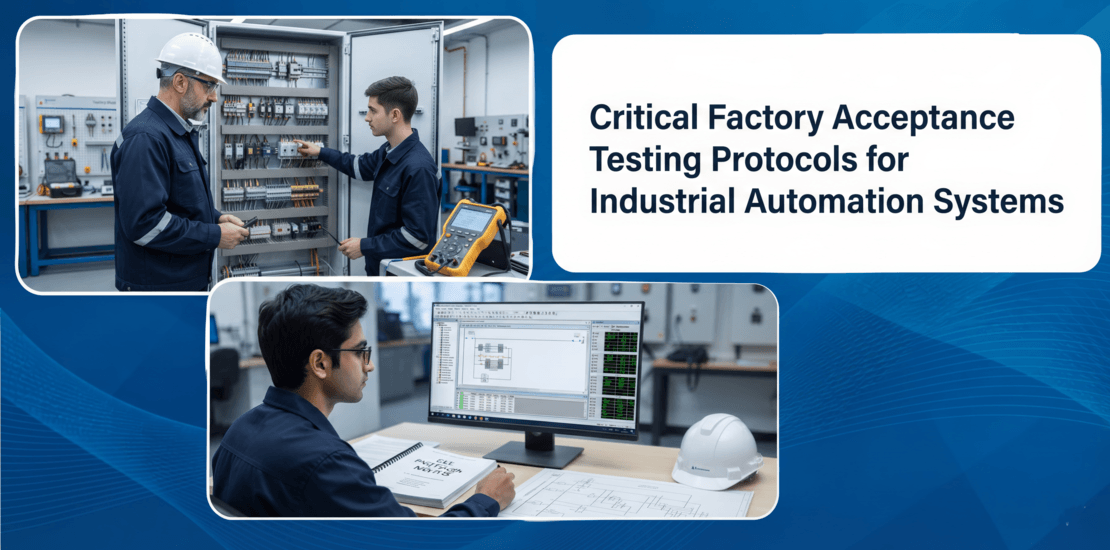
Factory Acceptance Testing services validate programmable logic controllers (PLC), distributed control systems (DCS), and safety instrumented systems (SIS) inside a controlled staging environment before site shipment. Through structured hardware inspection, I/O simulation, and PLC DCS FAT protocols, iPAC Automation eliminates field wiring errors, prevents startup delays, and ensures full regulatory audit compliance.
- 100% Hardware & Logic Verification: Executes point-to-point I/O loop checkout, alarm prioritization, and sequence validation prior to cabinet dispatch.
- Accelerated Site Commissioning: Cuts on-site turnaround windows by resolving firmware conflicts, network bottlenecks, and logic bugs off-site.
- Multi-Vendor Control Integration: Validates heterogeneous architectures spanning Rockwell, Siemens, Honeywell, and Yokogawa platforms under unified test scripts.
- Audit-Ready Sign-Off Dossiers: Delivers signed punchlists, redlined schematics, and witness test reports for EPCs and plant operators.
Critical Operational Challenges & Compliance Standards
Unverified control cabinets shipped directly to industrial sites create severe schedule overruns during greenfield startups and brownfield cutovers. Common field bottlenecks include mismatched terminal block assignments, uncalibrated analog scaling, incomplete SmartPlant Instrumentation (SPI) INtools loop sheets, and incompatible communication drivers between legacy fieldbuses and modern controllers. Correcting these defects under live plant turnaround constraints multiplies labor costs and risks unplanned process downtime.
Rigorous control system validation anchors every test procedure to internationally recognized engineering codes. IEC 61131-3 governs deterministic PLC programming languages and execution cycles, while IEC 61511 and ISA-84 mandate functional safety verification, fault-injection testing, and proof-test intervals for safety instrumented functions. Batch control logic and state transitions follow ISA-88 modular standards. Field instrument loop wiring and calibration adhere to API 551, and cabinet power-up, isolation, and high-voltage testing comply strictly with NFPA 70E electrical safety protocols. Aligning Factory Acceptance Testing services with these standards guarantees verifiable operational integrity before site delivery.
End-to-End Execution & Commissioning Methodology
As an independent industrial automation testing company, iPAC Automation executes a four-phase staging and validation methodology built for zero-defect site cutover.
Phase 1: Pre-Audit & Database Prep
Engineers perform a pre-commissioning audit of approved-for-construction (AFC) piping and instrumentation diagrams (P&IDs), cause-and-effect matrices, and control narratives. Using SPI INtools and master I/O registers, our team cross-checks tag names, engineering units, fail-safe states, and marshalling cabinet terminations to lock down a baseline FAT procedure.
Phase 2: Logic & Detail Design
Control specialists verify controller application code, PID loop tuning parameters, and HMI/SCADA faceplates across Rockwell Studio 5000, Siemens TIA Portal, and Honeywell Experion PKS. Engineers construct automated simulation routines that emulate field transmitters, motor control centers (MCCs), and shutdown valves without requiring live process equipment.
Phase 3: Staging & FAT
Cabinets are powered up in our staging bay for mechanical inspection, insulation resistance checks, and thermal profiling. Engineers execute formal PLC DCS FAT protocols: injecting 4–20 mA signals, HART diagnostics, and discrete inputs while witnessing alarm floods, interlock trips, and redundant controller failovers alongside Yokogawa PRM asset diagnostics.
Phase 4: Cutover & Site Validation
All FAT deviations are logged into a categorized punchlist (Category A, B, or C) and closed prior to shipment. Upon site delivery, engineers execute rapid Site Acceptance Testing (SAT), loop continuity checks, and hot-cutover commissioning under NFPA 70E controls to hand over a fully validated control system.
Engineering Deliverables & Scope Specification
| Project Stage | Core Client Deliverable | Industry Standard | Quality Sign-Off Criteria |
| Pre-FAT Audit | Master I/O List & Approved FAT Procedure | IEC 61131-3 / ISA-88 | 100% tag reconciliation against AFC P&IDs |
| Hardware Inspection | Panel Layout, BOM & Earthing Audit Report | NFPA 70E / UL 508A | Zero wiring faults; insulation tests passed |
| Functional Testing | Redlined C&E Matrix & Logic Test Logs | IEC 61511 / ISA-84 | All interlocks, trips, and alarms verified |
| Loop Simulation | I/O Loop Checkout & Calibration Sheets | API 551 | Analog accuracy within +/-0.1% full scale |
| Final Release | Signed FAT Certificate & Punchlist Closure | ISO 9001 / IEC 62381 | Zero open Category A/B defects at dispatch |
Site Risk Mitigation & Common Failure Modes
Three recurring technical failure modes frequently undermine industrial control system startups if left unaddressed during staging:
- Communication Buffer Overruns & Network Storms: High-density Modbus TCP, Profinet, or EtherNet/IP polling can saturate controller communication buffers and stall deterministic scan cycles. iPAC Automation conducts stress-testing at peak I/O traffic loads, enforces VLAN traffic segregation, and benchmarks controller CPU utilization below 50%.
- Unmapped Field Tags & Polarity Mismatches: Discrepancies between marshalling terminal blocks, SPI INtools wiring schedules, and PLC/DCS hardware trees cause inverted valve actions or dead channels. Our engineers execute physical terminal-to-HMI point-to-point verification for every active and spare I/O channel.
- Safety Interlock Race Conditions: Improperly sequenced startup permissives, timer resets, or first-out alarm latches can trigger nuisance trips during transient plant states. iPAC Automation runs dynamic state-transition simulations and power-loss recovery tests to eliminate race conditions before site shipment.
Engineering Scope Assessment & Inquiry: Planning a FAT/SAT Commissioning project? Submit your I/O list, existing P&IDs, or system architecture to iPAC Automation’s engineering team at https://ipacautomation.com/ for a rapid scope review, migration roadmap, or subcontracting estimate.
Frequently Asked Technical Questions
What is the primary difference between FAT and SAT in industrial automation?
Factory Acceptance Testing (FAT) validates control hardware, I/O wiring, and PLC/DCS logic at the vendor staging facility prior to shipment. Site Acceptance Testing (SAT) verifies physical field cabling, live sensor loops, and integrated plant utilities after installation on-site.
How are Category A, B, and C punchlist items managed during FAT?
Category A defects block system safety or core functionality and require immediate resolution before FAT sign-off. Category B items involve minor logic or HMI tweaks cleared prior to shipment, while Category C items cover cosmetic updates closed before SAT.
What documentation is required before starting a PLC/DCS FAT procedure?
A valid FAT requires Approved-for-Construction (AFC) P&IDs, a frozen I/O assignment list, a Cause-and-Effect (C&E) matrix, functional design specifications (FDS), and panel wiring schematics. Locking these baselines prevents scope drift and ensures traceable test execution.
Can virtual simulation replace physical I/O hardware during FAT?
Virtual I/O emulation accelerates early software logic debugging, but physical signal injection at marshalling terminals remains mandatory for critical loops. Combining digital twins with physical loop checks validates both software execution and physical cabinet wiring integrity.

