Ensuring Functional Safety Compliance: IEC 61511 Standards for Process Industry Operations
- November 17, 2026
- Posted by: Waman Sanap
- Category: Knowledge Hub
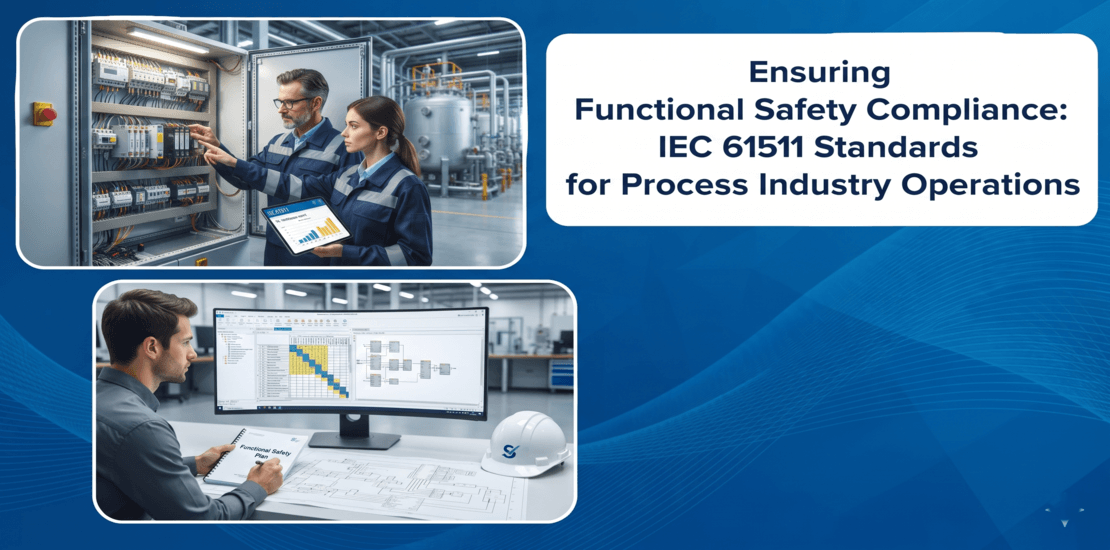
IEC 61511 compliance services govern the safety lifecycle of Safety Instrumented Systems (SIS) across chemical, oil and gas, and pharmaceutical plants. By combining Layer of Protection Analysis (LOPA), Safety Requirements Specifications (SRS), and disciplined Factory and Site Acceptance Testing, iPAC Automation reduces hazardous event risk while maintaining continuous process throughput and audit readiness.
- Complete SIS Lifecycle Coverage: Delivers Process Hazard Analysis (PHA) support, LOPA risk targets, SRS documentation, logic solver configuration, and proof-test procedures under IEC 61511 and ISA-84.
- Brownfield & Greenfield Execution: Resolves legacy PLC/SIS migration gaps, unverified field instrument loops, and fragmented engineering databases across live industrial facilities.
- Quantified Risk & Downtime Reduction: Targets verified Safety Integrity Level (SIL) performance to lower spurious trip rates and prevent catastrophic process incidents.
- Subcontracting & Turnkey Engineering: Provides EPCs and plant operators with rapid technical scoping, FAT/SAT witness execution, and Functional Safety Assessment (FSA) readiness.
Critical Operational Challenges & Compliance Standards
Process facilities face severe engineering bottlenecks during brownfield retrofits and greenfield expansions. Legacy safety relays and obsolete controllers often lack diagnostic visibility, forcing maintenance teams into manual proof testing that increases human error and unplanned shutdowns. In brownfield sites, field loop discrepancies, outdated piping and instrumentation diagrams (P&IDs), and missing SmartPlant Instrumentation (SPI) INtools records stall Safety Instrumented System (SIS) modifications. Meanwhile, separating basic process control system (BPCS) logic from Emergency Shutdown Systems (ESD) without clear cause-and-effect boundaries creates single-point failure risks.
Engineering execution must align with strict industrial standards across hardware, software, and site safety. IEC 61511 and ISA-84 define the process sector safety lifecycle, hazard assessment, and SIL verification requirements. IEC 61131-3 governs structured control and safety application programming, while ISA-88 organizes batch and procedural state boundaries. Field instrumentation installation and calibration reference API 551, and electrical safety during live panel and cabinet work follows NFPA 70E. Grounding every SIS modification in these codes establishes defensible audit trails for regulatory inspections and insurer reviews.
End-to-End Execution & Commissioning Methodology
iPAC Automation executes process safety lifecycle consulting through a structured four-phase engineering workflow designed for deterministic verification and minimal plant disruption.
Phase 1: Pre-Audit & Database Prep
Consultants audit existing P&IDs, cause-and-effect matrices, hazard and operability (HAZOP) studies, and LOPA worksheets to establish target Safety Integrity Levels (SIL) and demand mode classifications. Engineers reconcile tag lists, instrument ranges, and process setpoints inside SPI INtools and Excel master registers, flagging undocumented bypasses or mismatched I/O assignments before design starts.
Phase 2: Logic & Detail Design
Engineers author the Safety Requirements Specification (SRS), defining trip setpoints, voting architectures (1oo1, 1oo2, 2oo3), diagnostic intervals, and safe states. Control and safety engineers build and document application logic in Rockwell Studio 5000 (GuardLogix), Siemens TIA Portal (SIMATIC Safety), or Honeywell Experion PKS (Safety Manager), alongside cause-and-effect charts and wiring termination schedules.
Phase 3: Staging & FAT
Hardware assemblies and safety logic undergo staged Factory Acceptance Testing (FAT) using simulated field signals, fault injection, and power-loss scenarios. Engineers verify watchdog timers, trip response times, and diagnostic alarms while Yokogawa PRM or asset management tools validate smart transmitter diagnostics and proof-test intervals prior to shipment.
Phase 4: Cutover & Site Validation
During planned turnarounds or phased tie-ins, engineers enforce lock-out/tag-out and NFPA 70E arc-flash controls while executing loop checks and Site Acceptance Testing (SAT). Final sign-off confirms end-to-end sensor-to-final-element trip execution, updates as-built documentation, and supports Functional Safety Assessment (FSA) stage gates.
Engineering Deliverables & Scope Specification
| Project Stage | Core Client Deliverable | Industry Standard | Quality Sign-Off Criteria |
| Hazard & Risk Basis | LOPA Summary & SIL Target Register | IEC 61511-1 / ISA-84 | Risk reduction factors verified per scenario |
| Specification | Safety Requirements Specification (SRS) | IEC 61511-1 Cl. 10 | Approved trip limits, voting, and safe states |
| Logic & I/O Design | C&E Matrix, Loop Sheets & SIS Code | IEC 61131-3 / API 551 | Zero unmapped tags; peer logic review passed |
| Factory Testing | FAT Protocol & Witness Test Report | IEC 61511-1 Cl. 15 | 100% fault injection and trip tests passed |
| Site Commissioning | SAT Dossier & Proof-Test Procedures | IEC 61511 / NFPA 70E | Live loop trip verified; FSA checklist closed |
Site Risk Mitigation & Common Failure Modes
Three high-impact failure modes frequently derail Safety Instrumented Systems (SIS) commissioning and long-term operation:
- Communication Buffer Overruns & Scan Delays: High-frequency diagnostic polling or unthrottled HMI/historian traffic can saturate controller buffers and delay safety scan times. iPAC Automation segregates safety networks from standard plant traffic, enforces deterministic scan-time budgets, and verifies worst-case loop response times during FAT.
- Unmapped or Mismatched Field Tags: Discrepancies between P&IDs, SPI INtools databases, and PLC/SIS I/O tables cause wrong-channel trips or missed shutdowns. Our engineers run automated tag cross-checks and end-to-end physical loop verification from sensor terminals through logic solvers to shutdown valves and breakers.
- Safety Interlock Race Conditions: Improperly sequenced permissives, reset latches, or timer resets can create race conditions during startup or nuisance trips. iPAC Automation applies state-transition tables, scan-order analysis, and dynamic simulation testing before site cutover.
Engineering Scope Assessment & Inquiry: Planning a Functional Safety/SIL (IEC 61511) project? Submit your I/O list, existing P&IDs, or system architecture to iPAC Automation’s engineering team at https://ipacautomation.com/ for a rapid scope review, migration roadmap, or subcontracting estimate.
Frequently Asked Technical Questions
How does LOPA establish SIL targets under IEC 61511?
Layer of Protection Analysis (LOPA) quantifies initiating event frequency and independent protection layer probability of failure on demand against plant risk criteria. The remaining risk gap defines the required Safety Integrity Level (SIL) for the Safety Instrumented System (SIS) under IEC 61511.
What must a Safety Requirements Specification (SRS) include?
An SRS must define process safe states, hazardous event boundaries, sensor and final element requirements, voting logic, response times, maintenance bypass rules, and diagnostic coverage. Clear SRS baselines prevent scope creep and support independent Functional Safety Assessment (FSA) audits.
How are Emergency Shutdown Systems (ESD) separated from BPCS?
Emergency Shutdown Systems (ESD) operate on dedicated or segregated safety controllers with independent I/O, isolated power, and strict access controls separate from the basic process control system (BPCS). Separation prevents routine process control faults or operator errors from degrading safety integrity.
When should a Functional Safety Assessment (FSA) be conducted?
Functional Safety Assessments (FSA) should occur at defined lifecycle stages, including after SRS completion, prior to FAT, before hazardous commissioning/SAT, and during periodic operations. Early stage reviews catch specification or architecture gaps before costly hardware rework occurs.

Waman Sanap is the CEO of iPAC Automation, a leading instrumentation and control automation company. He has 20+ years of experience in the instrumentation engineering field.
