
How to optimize Plant Efficiency with Expert PLC Automation Programming Services
- July 15, 2026
- Posted by: Waman Sanap
- Category: Knowledge Hub
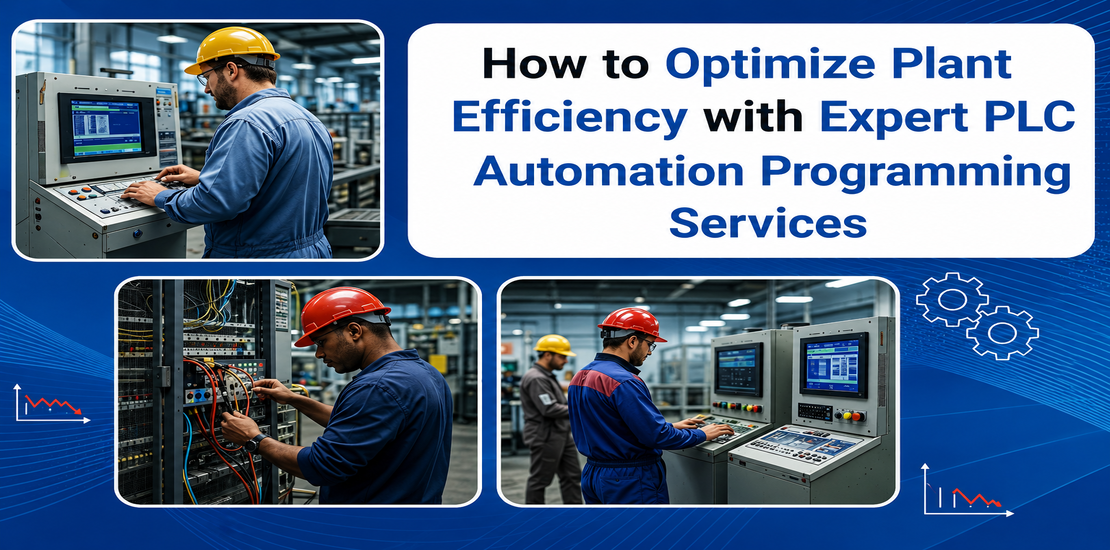
Industrial PLC Programming Services
PLC automation programming services encompass the specialized engineering lifecycle of designing, coding, testing, and deploying robust logic code within Programmable Logic Controllers to automate complex industrial machinery and manufacturing processes. These professional services ensure that automated systems maintain rigorous runtime reliability, fault tolerance, and deterministic performance under harsh operating conditions. Implementing optimized control logic directly translates to reduced cycle times, enhanced plant safety, and precise real-time diagnostic visibility across enterprise hardware networks.
Technical Architecture of Modern Industrial Automation Programming Services
Deploying factory automation requires an expert approach to control logic design. Industrial facilities operate on diverse hardware ecosystems where hardware-software synergy is non-negotiable. Modern control system layouts depend entirely on structured programming methodologies that conform strictly to international industrial engineering principles, notably the IEC 61131-3 standard.
Developing logic within this architectural framework involves mapping out hardware Input/Output (I/O) configurations, setting up deterministic task scheduling, and building standardized communications arrays. By relying on highly structured code frameworks, engineers can seamlessly integrate standalone control panels into a unified corporate data pipeline, eliminating operational friction between distinct factory assets.
Evaluating Complex Architecture: PLC Automation Programming Services vs. Distributed Control Systems (DCS)
When executing large-scale modernization or grassroot installations, industrial procurement managers must evaluate whether standalone controller programming or full Distributed Control Systems (DCS) architecture best fits their operational scope.
The following comparison table highlights key parameters analyzed by our engineering team:
| Architectural Parameter | PLC Automation Programming Services | Distributed Control Systems (DCS) |
| Primary System Focus | High-speed, discrete machine control & interlocking logic. | Continuous, highly complex process variables & loops. |
| Logic Execution Speed | Ultra-fast scan times (typically 1 to 10 milliseconds). | Slower execution routines (typically 100 to 500 milliseconds). |
| System Modification | Highly flexible; supports online dynamic runtime edits. | Rigid framework; requires structured system-wide compilation. |
| I/O Distribution | Ideal for localized or moderately distributed field assets. | Built natively for massive, geographically distributed architectures. |
| Common Protocols | Modbus TCP/RTU, PROFINET, EtherNet/IP. | Foundation Fieldbus, Profibus PA, Industrial Ethernet. |
Core Operational Benefits of Custom PLC Programming Solutions
Optimized Hardware Execution and Scalability
Generic, out-of-the-box logic blocks frequently contain redundant execution routines that place an unnecessary processing load on controller CPUs. Custom-tailored coding writes logic directly to your specific hardware configuration, which reduces internal CPU scan times. This optimization ensures that your physical inputs encounter near-zero response lag, drastically improving the operation of high-speed sorting systems, high-pressure safety valves, and synchronized multi-axis motion controls.
Seamless Operational Integration and Diagnostics
Experienced automation engineering practices focus heavily on the secondary integration layers of your system architecture. Properly structured control code includes comprehensive, standardized data blocks designed for immediate communication with top-level SCADA systems and Human-Machine Interfaces (HMIs).
This approach minimizes the time spent mapping tags during integration, while delivering clear, descriptive system alerts directly to control room operators. As a result, when a field instrument fails, the system points to the exact problem area instead of throwing a generic error code, keeping unexpected downtime to an absolute minimum.
iPAC Engineering Expert Insight:
“When programming logic for high-pressure or high-temperature processing units, always implement a dual-stage watchdog timer alongside non-volatile memory buffering (Retentive Tags). In the event of a sudden network power drop or an out-of-bounds communication time-out, retentive memory variables preserve the last verified operational state of the system. This practice prevents uncommanded valve transitions or sudden motor restarts when power is restored, protecting expensive physical plant assets and ensuring a safe, predictable return to operation.”
Maximizing Field Asset Reliability via PLC Programming and Commissioning Services
True system optimization extends far beyond typing lines of code in an engineering workstation; it demands thorough validation during live plant commissioning. The lifecycle of a robust implementation involves a strict multi-phase protocol:
- Offline Simulation and Factory Acceptance Testing (FAT): Before loaded onto physical field hardware, software logic undergoes exhaustive emulation via virtual PLC instances to catch logic conflicts, race conditions, or interlocking discrepancies.
- Loop Checked Hardware Verification: During site deployment, every physical wire and digital field network connection undergoes point-to-point verification to ensure that physical field transmitters match their assigned internal logic tags.
- Dynamic Site Acceptance Testing (SAT): The system undergoes live functional testing under actual operational loads, allowing engineers to fine-tune PID control loops, adjust process parameters, and verify emergency shutdown sequences.
B2B Industrial Automation FAQ
Where can I source certified industrial PLC programming company services in Dubai or the wider UAE region?
Certified industrial PLC programming services are readily available through iPAC Automation’s regional engineering offices. iPAC provides full-lifecycle engineering support across Dubai, Abu Dhabi, and the Northern Emirates, deploying field-certified automation specialists to manage everything from turnkey system migrations to complex software logic adjustments right on site.
What industries benefit most from custom PLC control system programming services in Saudi Arabia and Qatar?
Custom control system programming services are vital for heavy industries across Saudi Arabia (KSA) and Qatar, particularly within Oil & Gas extraction, petrochemical processing, large-scale seawater desalination facilities, and automated manufacturing plants. Custom control programming helps these facilities meet strict environmental regulations and maintain high production targets by ensuring precise, continuous process control.
How does an enterprise verify the code quality and engineering integrity of external PLC programming and commissioning services?
Code quality is verified by checking compliance with international design standards like IEC 61131-3, reviewing structured internal documentation, and conducting comprehensive Factory Acceptance Testing (FAT). Top-tier system integrators provide open, well-commented source code frameworks that feature detailed tag mapping, modular subroutines, and structured alarm blocks, allowing plant maintenance teams to easily manage long-term system updates.
Secure Plant Efficiency with iPAC Automation
Elevate your operational efficiency, eliminate system bottlenecks, and ensure absolute process safety with field-tested engineering solutions. iPAC Automation provides world-class control system integration, custom software design, and specialized multi-platform lifecycle support tailored for the complex demands of modern industrial environments. Submit Your Project Specifications / Request a B2B Engineering Consultation.

Waman Sanap is the CEO of iPAC Automation, a leading instrumentation and control automation company. He has 20+ years of experience in the instrumentation engineering field.
