
What are the best PLC and DCS migration services for Kuwait’s oil and gas?
- April 29, 2026
- Posted by: Waman Sanap
- Category: Knowledge Hub
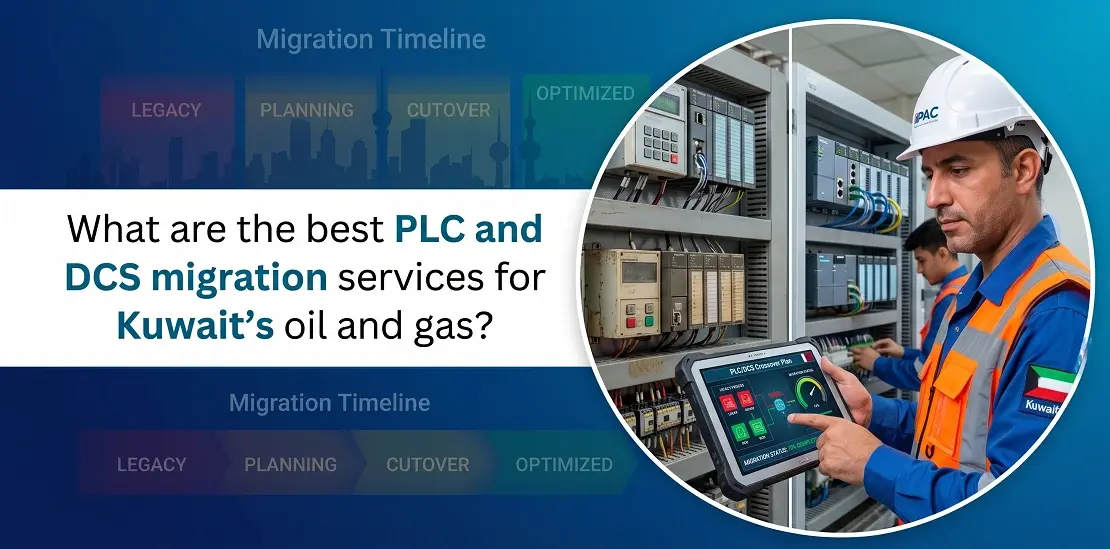
PLC and DCS migration services Kuwait in Energy Sector
PLC and DCS migration services involve the strategic transition of legacy control systems—such as Programmable Logic Controllers and Distributed Control Systems—to modern, integrated automation platforms to enhance operational reliability. In the Kuwaiti oil gas sector, these services are essential for maintaining the integrity of aging infrastructure while integrating advanced diagnostics, cybersecurity, and real-time data analytics required by K-Company standards (KOC/KNPC).
Key Takeaways for Migration Projects
- Risk Mitigation: Successful migrations utilize “Hot Cutover” techniques to ensure zero to minimal production downtime during the transition.
- Regulatory Alignment: Optimized PLC and DCS services ensure that facilities comply with Kuwait’s stringent environmental and safety regulations, including SIL (Safety Integrity Level) requirements.
- Operational Efficiency: Modernizing legacy hardware allows for the integration of IIoT (Industrial Internet of Things) and predictive maintenance, reducing long-term OPEX.
- System Longevity: Migration addresses the “end-of-life” status of obsolete hardware from manufacturers like Honeywell, ABB, and Siemens, securing the supply chain for spare parts.
The Strategic Necessity of PLC and DCS Migration in Kuwait
The Kuwaiti oil gas sector operates some of the most complex “brownfield” environments in the world. As legacy systems reach their 20- or 30-year milestones, the risk of unforced outages increases significantly. Industrial data suggests that obsolete control systems are responsible for a 15% higher rate of unplanned maintenance compared to modern digital architectures.
Comprehensive PLC and DCS migration services go beyond simple hardware replacement. They involve a total audit of the logic, loops, and HMI (Human-Machine Interface) to ensure the new system reflects modern process safety and efficiency standards.
Comparison: Migration Strategies for Oil & Gas Facilities
Choosing the right approach is critical to project success. The following table compares the two primary methodologies used in the GCC region:
| Feature | Hot Cutover (Phased) | Cold Cutover (Total Shutdown) |
| Downtime | Near Zero / Transparent | Requires Full Plant Shutdown |
| Risk Profile | High Complexity / Low Production Risk | Lower Complexity / High Financial Risk |
| Execution Time | Extended Duration | Short, Intense Window |
| Cost Impact | Higher Labor / Lower Revenue Loss | Lower Labor / Significant Revenue Loss |
| Best For | Continuous Processing (Upstream) | Turnaround / Maintenance Windows |
Technical Excellence in PLC and DCS Services
To achieve the “Best” status in Kuwait, PLC and DCS services must integrate seamless communication between disparate systems. Fact-based engineering protocols dictate that modern migrations should utilize open-standard communication (like OPC UA or Modbus TCP/IP) to prevent vendor lock-in and ensure future scalability.
Addressing Cybersecurity and Safety Standards
In the modern energy landscape, a control system is only as good as its security. The integration of PLC and DCS services in 2026 requires strict adherence to IEC 62443 standards for industrial cybersecurity. This includes network segmentation, encrypted data flows, and robust firewalls to protect Kuwait’s critical energy infrastructure from external threats.
Furthermore, migration provides an opportunity to upgrade Safety Instrumented Systems (SIS). By aligning the DCS with updated SIL 2 or SIL 3 standards, operators can significantly reduce the probability of catastrophic failure in high-pressure environments.
Expert Tip & FAQ
Expert Tip: Before initiating a migration, conduct a “Logic Verification Audit.” Often, legacy code contains patches or “ghost logic” from decades of operation. Cleaning this logic before migrating to a new platform prevents the transfer of old inefficiencies into your new, high-performance system.
FAQ: Navigating Migration Challenges
Q: Why is migration better than maintaining legacy systems?
A: Legacy systems suffer from “part obsolescence.” When a critical card fails and is no longer manufactured, the resulting downtime can cost millions. Migration ensures a 15–20 year lifecycle of supported operation.
Q: Can these services be performed during active production?
A: Yes. Through specialized PLC and DCS migration services known as “Hot Cutovers,” technicians can migrate loops one by one while the plant remains live, though this requires meticulous planning and expert execution.
Q: How do these services improve energy efficiency?
A: Modern DCS platforms offer advanced process control (APC) algorithms that optimize fuel and energy consumption in real-time, directly contributing to Kuwait’s sustainability goals.
Conclusion: Partnering for Success in the Kuwaiti Oil Gas Sector
The transition from legacy hardware to modern automation is a defining factor in the operational resilience of Kuwait’s energy assets. High-quality PLC and DCS migration services act as a bridge between historical reliability and future innovation. By prioritizing risk management, cybersecurity, and regulatory compliance, facilities can extend their asset life by decades while significantly improving their bottom line.
At iPAC Automation, we bring global expertise to the Kuwaiti oil gas sector, offering end-to-end PLC and DCS services that are as robust as they are innovative. We understand the high stakes of energy production and provide the technical precision required to modernize your infrastructure without compromising your output.
Ready to Future-Proof Your Operations?
Don’t let obsolete systems become a liability. Secure your facility’s future with the industry’s most reliable migration experts.
Contact iPAC Automation today for a comprehensive site assessment and migration roadmap.
- Visit Us: https://ipacautomation.com/
- Inquiry: [sales@ipacautomation.com]
- Global Support: Providing world-class automation solutions for the GCC energy sector.
Let’s optimize, modernize, and secure your production together.

Waman Sanap is the CEO of iPAC Automation, a leading instrumentation and control automation company. He has 20+ years of experience in the instrumentation engineering field.
