
Why UAE Factories are Moving Toward Modular PLC Programming Services?
- May 12, 2026
- Posted by: Waman Sanap
- Category: Knowledge Hub
Key Takeaways for UAE Industrial Leaders
- Reduced Operational Downtime: Modular PLC Programming Services structures allow for localized updates without halting entire production lines, significantly decreasing mean time to repair (MTTR).
- Rapid Scalability: Code blocks developed for one machine can be replicated across new production lines, accelerating the expansion of PLC programming for manufacturing plants.
- Simplified Maintenance: Advanced PLC troubleshooting services become more efficient as faults are isolated within specific software modules rather than obscured in monolithic code.
- Alignment with UAE 4IR: Adopting modular standards directly supports the UAE’s “Operation 300bn” strategy, fostering smarter, more flexible industrial ecosystems.
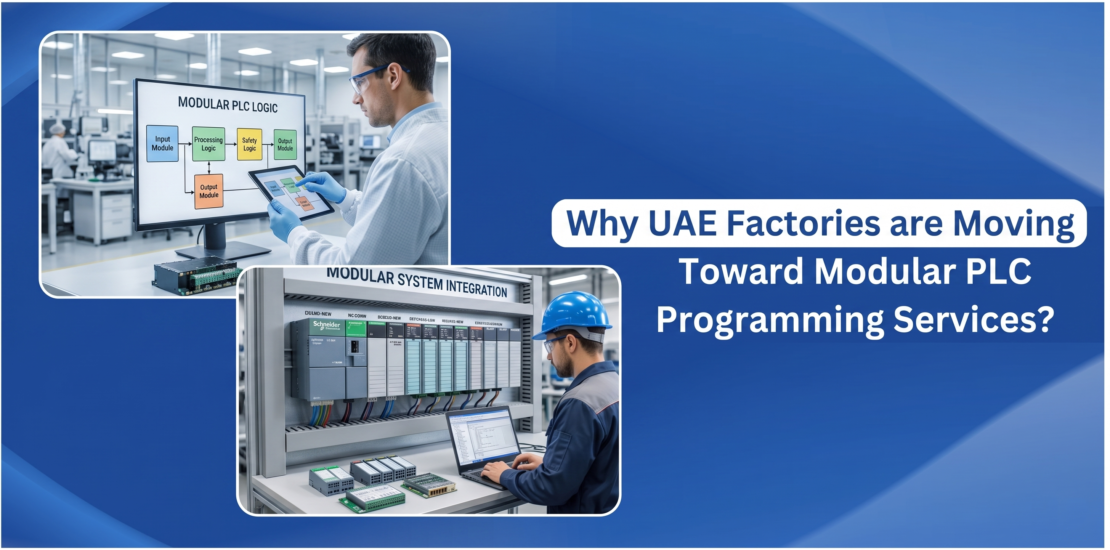
Modular PLC Programming Services have become the technical cornerstone for modern manufacturing facilities in Dubai, Abu Dhabi, and across the Northern Emirates, providing the agility required to compete in a global market.
Defining PLC Programming Services
PLC Programming Services are specialized engineering processes used to design, code, and implement the control logic for Programmable Logic Controllers (PLCs) that manage industrial machinery. In a modular framework, these services break down complex automation tasks into independent, reusable code blocks, such as Function Blocks (FB) or Data Blocks (DB). This architecture ensures that Industrial PLC automation solutions are more resilient, easier to debug, and simpler to integrate with SCADA and IIoT platforms.
The industrial landscape in the UAE is undergoing a rapid digital transformation. As factories transition toward smart manufacturing, the demand for Custom PLC control system development has shifted from traditional, linear “spaghetti code” to highly organized, modular architectures.
1. Enhanced Troubleshooting and Diagnostic Speed
In high-output environments like food processing or petrochemicals, a single minute of downtime carries a heavy financial penalty. Advanced PLC troubleshooting services are inherently faster when the system is modular. Technicians can isolate specific functional units—such as a “Conveyor Module” or a “Filling Station Module”—without scanning through thousands of rungs of Ladder Logic. Technical data shows that modular code can reduce diagnostic time by up to 40% compared to monolithic structures.
2. Standardization Across Diverse Hardware
UAE factories often utilize a mix of hardware from global vendors like Siemens, Rockwell Automation, and Schneider Electric. Modular programming facilitates a “hardware-agnostic” approach to logic. By creating standardized functional templates, engineers can deploy consistent PLC programming for manufacturing plants regardless of the specific controller hardware, ensuring a unified operator experience and easier spare parts management.
Comparison: Modular vs. Monolithic PLC Programming
| Feature | Monolithic (Traditional) Programming | Modular PLC Programming Services |
| Code Structure | Single, continuous stream of logic | Independent, reusable functional blocks |
| Scalability | Difficult; requires major rewrites | Easy; simply add or replicate modules |
| Debugging | Time-consuming; errors can cascade | Rapid; faults are isolated to specific units |
| Standardization | Low; often unique to each programmer | High; follows global IEC 61131-3 standards |
| Initial Setup Time | Moderate | Higher (requires more planning) |
| Long-term Cost | High (due to maintenance & downtime) | Low (due to efficiency & reusability) |
3. Future-Proofing with Industry 4.0 and IIoT
The integration of Industrial PLC automation solutions with cloud-based analytics requires clean, structured data. Modular programming facilitates the use of “Object-Oriented” concepts in automation. Each module can be assigned specific tags and parameters that are easily recognized by Edge Computing devices and SCADA systems. This structure is essential for factories aiming to implement predictive maintenance and real-time performance monitoring.
Core Benefits for UAE Manufacturers:
- Rapid Reconfiguration: Switch production lines for different products in hours rather than days.
- Improved Safety: Safety-instrumented functions (SIF) can be isolated within dedicated modules to ensure compliance with international safety standards (SIL).
- Global Collaboration: Standardized modular code allows remote engineering teams to collaborate on Custom PLC control system development with local UAE staff seamlessly.
Expert Tip: The “Library” Strategy
Expert Tip: To maximize ROI, industrial managers should insist that their automation partners develop a “Corporate Functional Library.” By archiving tested and validated modular code for common tasks (e.g., motor control, PID loops, valve sequencing), you create a proprietary asset that slashes the cost of future PLC Programming Services by as much as 30% for subsequent projects.
FAQ: Navigating Modular Automation in the UAE
Q: Can existing “legacy” factory systems be converted to modular programming?
A: Yes. Through a process of refactoring, Advanced PLC troubleshooting services can identify critical sections of old code and gradually replace them with modular blocks during scheduled maintenance windows, minimizing disruption.
Q: Is modular programming more expensive upfront?
A: While the initial design phase for Custom PLC control system development requires more meticulous planning and engineering hours, the reduction in commissioning time and long-term maintenance costs typically results in a lower Total Cost of Ownership (TCO) within the first 12–18 months.
Q: Which programming languages support modularity best?
A: While Ladder Logic (LD) is widely used, Structured Text (ST) and Function Block Diagrams (FBD) are the preferred languages for creating complex, high-performance modular libraries.
Optimize Your Factory Performance with iPAC Automation
The transition to smarter, modular industrial systems is a necessity for staying competitive in the UAE’s evolving economy. At iPAC Automation, we specialize in world-class PLC Programming Services that prioritize reliability, scalability, and ease of use. Whether you require a new system build or an upgrade to your existing infrastructure, our team delivers precision-engineered solutions tailored to the unique demands of Middle Eastern manufacturing.
[Contact iPAC Automation Today to Upgrade Your Industrial PLC Automation Solutions].

Waman Sanap is the CEO of iPAC Automation, a leading instrumentation and control automation company. He has 20+ years of experience in the instrumentation engineering field.
