
Reliable Control Panel and Hardware Engineering Services for Saudi Facilities
- September 16, 2026
- Posted by: vishal pharos
- Category: Uncategorized
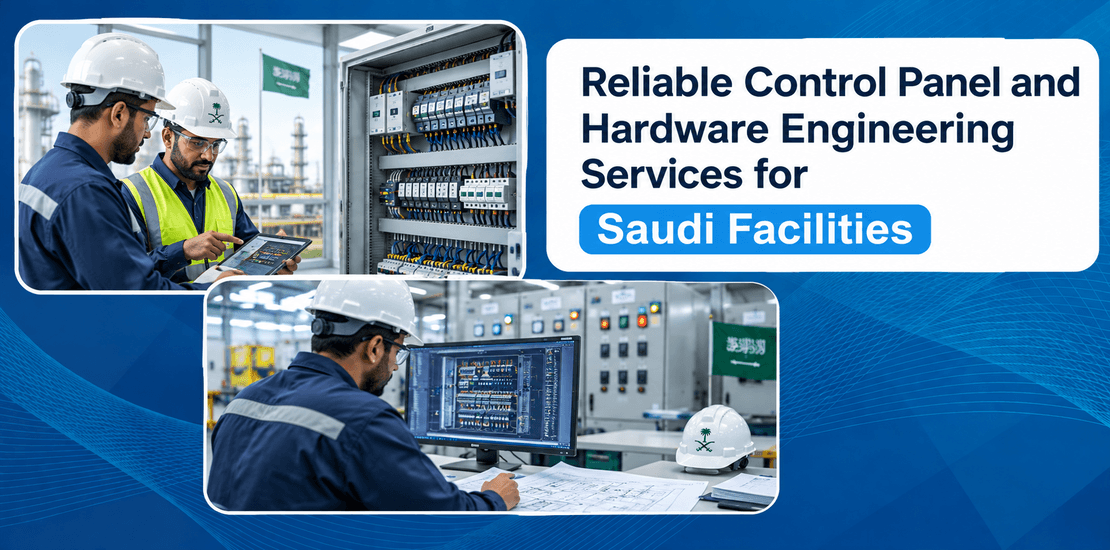
Control Panel and Hardware Engineering Services for Saudi Facilities
Reliable control panel and hardware engineering services deliver specialized electrical schematic drafting, short-circuit current calculations, thermal load profiling, and physical enclosure design strictly compliant with regional industrial guidelines and international IEC 61439/UL 508A standards. Industrial automation standards dictate that control hardware operating within the Kingdom of Saudi Arabia (KSA) must withstand persistent ambient heat, severe dust-loading, and hazardous area conditions while maintaining uninterrupted signal integrity between field devices and central processing infrastructure. iPAC Automation delivers engineering-grade control panel design, assembly coordination, and comprehensive validation testing for downstream petrochemical plants, upstream oil facilities, and advanced manufacturing infrastructure across Saudi Arabia.
Technical Foundations: Hardware Reliability in Saudi Industrial Environments
Deploying hardware across Jubail, Yanbu, Ras Tanura, and the broader Eastern Province presents extreme operational challenges. Ambient summer temperatures frequently breach 52°C, relative humidity spikes along the coasts, and fine desert sands penetrate unsealed assemblies. Under these environmental profiles, standard industrial enclosures suffer from heat-induced micro-controller crashes, accelerated copper busbar oxidation, and catastrophic short circuits.
Implementing engineered control panel and hardware engineering services establishes an unbroken technical baseline across design, component selection, and structural fabrication:
Critical Saudi Facility Engineering Requirements
- Enclosure Material and Ingress Protection: Enclosures located in harsh or coastal industrial corridors require AISI 316L stainless steel construction or heavy-duty electro-galvanized sheet steel with certified polyurethane gaskets achieving IP65/IP66 or NEMA 4X ratings.
- Thermal Load Calculations: Sizing calculation reports must evaluate internal heat dissipation from high-density variable frequency drives, DC power supplies, and control cards. Industrial automation standards dictate that internal enclosure temperatures must remain within equipment operational envelopes without relying on unfiltered ambient air.
- Hazardous Area Classification: Assemblies positioned near hydrocarbon processing units require precise segregation and explosion-proof designs conforming to Class I, Division 1 / Division 2 (NEC 500) or Zone 1 / Zone 2 (IECEx/ATEX), complete with certified purge-and-pressurization systems or intrinsic safety (IS) barriers.
- Segregation and Busbar Fault Withstand: High-capacity power distribution demands copper busbar bracing calculated to withstand high prospective fault currents in full compliance with IEC 61439-1/2 or UL 508A.
Architectural Topologies: Custom Automation & Power Panels
To safeguard operations and simplify maintenance, industrial facilities separate control, field interfacing, and heavy power distribution into discrete panel topologies:
1. Automation, System, and Marshalling Infrastructure
- System Cabinets: House dual-redundant programmable logic controller (PLC) CPUs, distributed control system (DCS) controller nodes, communications gateways, and regulated 24VDC power supply assemblies. Structural wiring channels segregate AC auxiliary supplies from sensitive DC logic busses to prevent electromagnetic interference (EMI).
- Marshalling Cabinets: Serve as the high-density physical interface where multi-core field cables terminate. Accommodates knife-edge disconnect terminals, passive surge protection barriers, galvanic isolators, and cross-wiring matrices, safeguarding database integrity between physical field instruments and system I/O modules.
- Local Control Panels (LCP) & RTU Enclosures: Ruggedized, skid-mounted operator stations positioned in process areas to facilitate localized equipment start/stop sequencing, valve actuation, and emergency trip execution. Remote Terminal Unit (RTU) panels provide telemetry across remote wellpads and pipeline manifolds.
- Interposing Relay Panels (IRP): Galvanically isolate low-voltage PLC/DCS transistor outputs from high-voltage motor control circuits and solenoid coils, preventing inductive voltage spikes from damaging control boards.
2. Motor Control, Drives & Energy Distribution
- Motor Control Centers (MCC) & Power Control Centers (PCC): Low-voltage compartmentalized boards equipped with molded case circuit breakers (MCCBs), motor circuit protectors, and intelligent overload relays. Form 3b and Form 4b internal segregation isolates busbars, functional motor units, and cable termination spaces.
- Variable Frequency Drive (VFD) Panels: Dynamic motor speed regulation cabinets engineered with harmonic line reactors, du/dt or sine-wave output filters, bypass contactors, and high-capacity cooling equipment.
- Automatic Power Factor Correction (APFC) Panels: Heavy-duty capacitor banks with detuned reactors designed to correct lagging power factors in large inductive plants, reducing utility penalty charges and optimizing transformer load capacities.
- Synchronizing Panels & Automatic Transfer Switches (ATS): Manage synchronization parameters (voltage, frequency, and phase angle) across captive diesel generators and utility incomers to guarantee uninterrupted power transition during grid anomalies.
3. Functional Safety and Protection Cabinets
- Emergency Shutdown (ESD) & Fire and Gas (F&G) Panels: Dedicated, SIL-2/SIL-3 certified safety instrumented system (SIS) enclosures. Built using triple modular redundant (TMR) architectures, fail-safe relay logic, and optical flame/gas detector interfaces to initiate automatic plant trips during process upsets.
- Relay & Protection Panels: Custom utility-grade protection racks containing numerical relays that monitor feeder, transformer, and busbar health with high-speed differential and overcurrent trip logic.
Technical Comparison:
| Hardware Engineering Parameter | Standard Commercial Assembly | iPAC Engineered Panel Solutions |
| Electrical Schematic Design | Basic 2D drafting; unlinked terminals | Multi-layer intelligent schematics via EPLAN Electric P8 & AutoCAD Electrical |
| Spatial & Mechanical Verification | Manual visual inspection; prone to site clash | Full 3D enclosure modeling and interference checks via SolidWorks |
| Thermal Profiling & Sizing | Passive convection venting louvers | Finite thermal calculations; sizing of closed-loop AC and vortex coolers |
| Busbar Design & Dynamics | Standard sizing based solely on continuous load | Short-circuit withstand sizing & clearance/creepage analysis per IEC 61439 |
| Quality Control & Testing | Sample spot-check continuity tests | 100% point-to-point continuity, logic simulation, dielectric & megger testing |
| Handover Documentation | Generic single-line diagram and basic parts list | Complete O&M dossiers, certified test sheets, cable schedules, and as-built drawings |
iPAC Engineering Expert Insight:
In Saudi industrial zones where sulfur-bearing gases and high airborne salinity are present, never use standard tin-plated copper busbars or unsealed terminal blocks. Atmospheric airborne sulfur reacts with copper to form copper sulfide, causing micro-pitting, elevated resistance, and severe busbar overheating. For critical installations across KSA, always mandate full silver or electro-tin plating with an anti-fungal conformal coating on internal PCB cards. Furthermore, ensure that the panel gland plates utilize 316-grade stainless steel or brass rather than standard mild steel to eliminate galvanic corrosion and maintain enclosure grounding continuity throughout the plant’s operational lifecycle.
Phased Engineering Lifecycle: Concept to Commissioning
Every control panel project executed by iPAC Automation follows a standardized, fully auditable engineering sequence:
- Pre-Engineering & Philosophy Review: Verification of client datasheets, process P&IDs, load lists, and single line diagrams. Selection of core standards (IEC 61439, UL 508A, or SASO requirements) and formalization of the Design Basis document.
- Detailed Electrical Schematics: Drafting comprehensive power schematics, control interlocking circuits, ferrule schedules, and terminal junction diagrams using EPLAN Electric P8 and AutoCAD Electrical.
- General Arrangement & 3D Spatial Modeling: Constructing precise 3D general arrangement models in SolidWorks to verify component heat clearances, ergonomics of door-mounted HMIs, cable-bending radiuses, and gland plate entries.
- Calculations & Bill of Materials: Completing short-circuit calculations, busbar current density verification, enclosure heat dissipation calculations, and part selection mapped to client-approved vendor lists (e.g., Rockwell Automation, Siemens, Schneider Electric, ABB, Eaton).
- Testing & Quality Assurance (FAT / SAT): Supervising strict Factory Acceptance Testing protocols alongside plant engineers and third-party inspectors—including dielectric Hi-Pot checks, point-to-point continuity confirmation, and functional logic simulation—followed by site-level SAT commissioning and as-built documentation delivery.
Upgrade Your Plant Infrastructure with iPAC Automation
Whether your facility requires heavy-duty motor control centers, high-density DCS marshalling suites, or hazardous-area certified system cabinets, iPAC Automation delivers engineering-grade hardware solutions designed for industrial environments across Saudi Arabia and the wider GCC region.
Partner with our engineering team to eliminate project schedule risks, ensure compliance with international codes, and secure reliable control hardware for your plant.
- Submit Your RFP & Specifications: Contact iPAC Automation Regional Engineering
- Direct Engineering Support: sales@ipacautomation.com
Frequently Asked Questions for Saudi Plant Engineers & Procurement Teams
How do environmental conditions in Saudi Arabia influence industrial control panel design?
High ambient temperatures exceeding 50°C and pervasive airborne dust require specific design interventions. These include sizing closed-loop cooling units or heat exchangers to prevent external air contamination, utilizing NEMA 4X or IP66-rated 316L stainless steel enclosures, and applying protective conformal coatings on electronic cards to resist chemical corrosion and dust deposition.
What is the role of an interposing relay panel (IRP) in heavy process facilities?
An interposing relay panel creates galvanic isolation between low-voltage digital I/O modules (such as 24VDC PLC outputs) and high-voltage field loads (such as 120VAC/230VAC motor starter coils or solenoid valves). This physical separation prevents inductive kickback, electrical noise, and ground-loop faults from damaging primary controller processors.
Can iPAC Automation accommodate specific Approved Vendor Lists (AVL) for KSA projects?
Yes. Our engineering team designs and sources hardware in strict accordance with client-approved vendor lists. We regularly engineer assemblies integrating components from Rockwell Automation (Allen-Bradley), Siemens, Schneider Electric, ABB, Eaton, Phoenix Contact, and Rittal.
What verification testing is performed during the Factory Acceptance Test (FAT)?
The FAT protocol includes 100% point-to-point electrical continuity testing, insulation resistance (megger) and high-potential (Hi-Pot) dielectric tests, operational simulation of control logic and protective trips, dimensional verification against approved GA drawings, and torque checks on all power busbars and terminals. All results are compiled into a formal FAT closure package prior to shipping authorization.

