Optimizing Control Systems: Advanced DCS Upgrades and PLC Migration Strategies for Modern EPC Plants
- November 23, 2026
- Posted by: Waman Sanap
- Category: Knowledge Hub
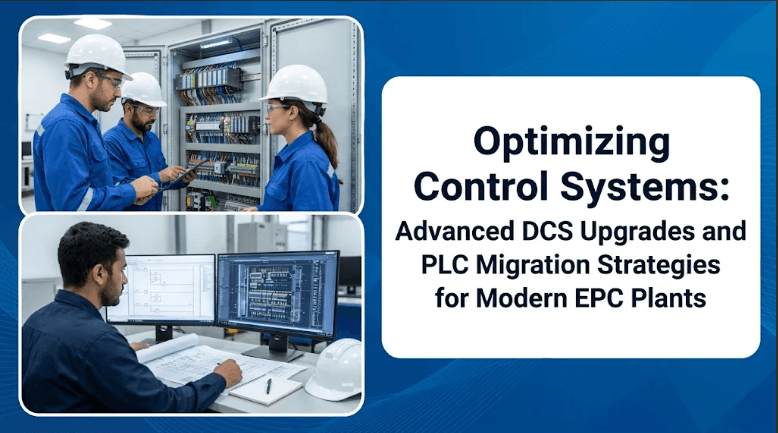
DCS upgrade services and legacy control system modernization replace obsolete Distributed Control System (DCS) and Programmable Logic Controller (PLC) platforms with high-availability architectures. Using database-driven tag mapping, dual-redundant staging, and hot-cutover protocols, iPAC Automation executes zero-downtime migrations that eliminate hardware obsolescence, restore regulatory compliance, and protect continuous EPC plant throughput.
- Turnkey Lifecycle Execution: Delivers full-scope hardware auditing, I/O marshalling redesign, control logic conversion, HMI graphic migration, and FAT/SAT validation.
- Zero-Downtime Cutover Architecture: Employs parallel network bridges, swing-arm termination assemblies, and phased loop transfers to minimize process turnaround windows.
- Multi-Platform Engineering Proficiency: Executes cross-vendor migrations across Honeywell Experion PKS, Rockwell Studio 5000, Siemens TIA Portal, and Yokogawa CENTUM platforms.
- EPC-Ready Documentation & Compliance: Reconciles as-built P&IDs, SPI INtools databases, and safety interlocks under IEC 61131-3, IEC 61511, and ISA-88 standards.
Critical Operational Challenges & Compliance Standards
Brownfield process facilities operating legacy Distributed Control System (DCS) and Programmable Logic Controller (PLC) hardware face acute operational risks from discontinued OEM spare parts, unsupported Windows-based operator stations, and proprietary fieldbus bottlenecks. In many EPC plant retrofits, decades of undocumented field modifications leave critical engineering gaps: unmapped marshalling cabinet terminals, missing SmartPlant Instrumentation (SPI) INtools loop records, and mismatched cause-and-effect (C&E) logic. Executing obsolete hardware replacement without resolving these baseline discrepancies triggers extended startup delays and unplanned process trips.
As an experienced PLC migration contractor, iPAC Automation anchors every modernization project to strict international engineering codes. IEC 61131-3 standardizes structured PLC/DCS application code conversion and deterministic scan execution. IEC 61511 and ISA-84 govern safety instrumented function (SIF) segregation, voting logic integrity, and proof-test verification when upgrading regulatory control alongside safety systems. Batch sequencing and recipe transitions align with ISA-88 modular state models. Field transmitter wiring, hazardous-area barriers, and loop calibration comply with API 551, while live panel hot-cutover and cabinet isolation strictly follow NFPA 70E electrical safety mandates.
End-to-End Execution & Commissioning Methodology
iPAC Automation executes legacy control system modernization through a four-phase engineering workflow engineered for deterministic cutover and zero unscheduled downtime.
Phase 1: Pre-Audit & Database Prep
Engineers audit installed control cabinets, controller memory maps, network topologies, and existing piping and instrumentation diagrams (P&IDs). Using SPI INtools and automated tag-extraction scripts, our team reconciles every analog and discrete I/O point, alarm priority, and scaling range, generating a master migration database and hardware bill of materials (BOM).
Phase 2: Logic & Detail Design
Control specialists convert legacy ladder, function block, and proprietary controller code into modern, standardized architectures across Honeywell Experion PKS, Rockwell Studio 5000, and Siemens TIA Portal. Engineers produce updated loop wiring diagrams, marshalling termination schedules, and high-performance ISA-101 HMI displays while preserving validated PID tuning parameters.
Phase 3: Staging & FAT
New controller racks, redundant servers, and custom swing-arm marshalling adapters undergo full staging for Factory Acceptance Testing (FAT). Engineers execute closed-loop process simulations, fault-injection scenarios, and redundant controller failover benchmarks while validating smart field diagnostics through Yokogawa PRM prior to site shipment.
Phase 4: Cutover & Site Validation
During scheduled plant turnarounds or live hot-cutover windows, engineers enforce NFPA 70E safety boundaries to swap termination assemblies, verify point-to-point loop continuity, and run Site Acceptance Testing (SAT). Final commissioning hands over updated as-built schematics, redlined P&IDs, and verified backup archives.
Engineering Deliverables & Scope Specification
| Project Stage | Core Client Deliverable | Industry Standard | Quality Sign-Off Criteria |
| Pre-Migration Audit | Master I/O Register & Obsolescence Report | API 551 / ISA-88 | 100% physical tag match to AFC P&IDs |
| Detail Engineering | Loop Sheets, Panel Drawings & C&E Matrix | IEC 61131-3 / UL 508A | Zero unmapped channels; peer design sign-off |
| Logic & HMI Conversion | Converted Control Code & HMI Graphics | IEC 61131-3 / ISA-101 | Identical control response in simulation |
| Factory Acceptance | FAT Witness Report & Redundant Failover Log | IEC 62381 / IEC 61511 | Zero open Category A/B punchlist defects |
| Site Commissioning | SAT Certificate & As-Built SPI Database | NFPA 70E / ISO 9001 | All loops verified; plant handover signed |
Site Risk Mitigation & Common Failure Modes
Three high-risk failure points frequently disrupt brownfield Distributed Control System (DCS) and Programmable Logic Controller (PLC) migrations if left unmitigated:
- Communication Buffer Overruns & Protocol Latency: Bridging legacy serial/proprietary networks to modern EtherNet/IP, Profinet, or Modbus TCP architectures can overload gateway buffers and delay I/O updates. iPAC Automation calculates deterministic bandwidth budgets, isolates control VLANs, and stress-tests peak scan loads during FAT.
- Unmapped Field Tags & Hidden Software Latches: Undocumented bypass bits, hardcoded constants, and mismatched SPI INtools terminal assignments cause erratic actuator behavior during cutover. Our engineers run line-by-line code cross-references and physical terminal-to-faceplate verification before energizing field loops.
- Safety Interlock Race Conditions: Improperly sequenced startup permissives or differing scan-order execution between legacy and modern processors can trigger nuisance shutdowns. iPAC Automation executes dynamic state-transition testing and power-cycle recovery drills to eliminate race conditions prior to site cutover.
Engineering Scope Assessment & Inquiry: Planning a Legacy DCS/PLC Migration project? Submit your I/O list, existing P&IDs, or system architecture to iPAC Automation’s engineering team at https://ipacautomation.com/ for a rapid scope review, migration roadmap, or subcontracting estimate.
Frequently Asked Technical Questions
How do DCS upgrade services achieve zero-downtime cutover in live plants?
Zero-downtime cutover uses parallel communication gateways, pre-wired swing-arm marshalling adapters, and phased loop-by-loop transfer protocols. Engineers migrate non-critical process units online while staging critical loops for rapid, deterministic switchover during brief planned maintenance windows.
What is required before starting a legacy PLC or DCS migration?
A successful migration requires existing controller program backups, Approved-for-Construction (AFC) P&IDs, marshalling cabinet wiring schedules, and an updated I/O assignment list. Conducting a physical pre-audit resolves undocumented field changes before detail engineering begins.
Should obsolete PLC and DCS hardware be replaced via rip-and-replace or phased migration?
Phased migration suits continuous process plants unable to tolerate extended shutdowns, allowing incremental I/O and controller upgrades. Complete rip-and-replace fits major turnarounds where aging backplanes, power supplies, and field cabling require total lifecycle renewal.
How does EPC automation engineering maintain safety compliance during control upgrades?
EPC automation engineering segregates Basic Process Control System (BPCS) logic from Safety Instrumented Systems (SIS) under IEC 61511 and ISA-84. Every modified interlock undergoes updated Cause-and-Effect verification, fault injection during FAT, and documented Site Acceptance Testing.

Waman Sanap is the CEO of iPAC Automation, a leading instrumentation and control automation company. He has 20+ years of experience in the instrumentation engineering field.
